Acquiring a customer is a win, but this does not imply that the deal is now closed and work is done. Because after this, a question arises, and that is –
How much is that customer actually worth to your business over time?
This is where customer lifetime value, also known as CLV calculations, comes into the picture. It is important to know that it is not just a mere metric anymore. It is a lens that gives businesses the vision of growth, retention, and long-term profitability. It is essentially what customer success metrics ultimately attest to.
This article aims to simplify the concept for a better understanding and will also help identify some common mistakes that teams often tend to make.
What is CLV (Customer Lifetime Value)?
Customer Lifetime Value (CLV) is the total revenue a business can expect from a customer throughout their relationship. It is the answer to the question of –
If we acquire this customer today, how much value will they generate before they leave?
The term to keep in mind here is “lifetime”. CLV is about the entire journey and not just one interaction.
Why CLV Calculation Matters More Than Ever
Many businesses are turning to subscription and SaaS based business models. For them, revenue does not come from a one-time transaction. It is, in fact, something that is built over time. A 3:1 LTV-to-CAC ratio is the standard industry benchmark for sustainable profitability, with SaaS and B2B experts recommending a 3:1 to 5:1 range.
Customers are not just mere closed deals; they are ongoing sources of revenue. Through CLV calculation, one can –
- Understand how much they can spend on acquisition
- Identify high-value customer segments
- Prioritize retention and expansion efforts
- Predict long-term revenue with more clarity
Since teams already have a hint, decisions become reactive. In this way, growth becomes intentional.
The CLV Calculation Formula
There are multiple ways to calculate CLV depending on the level of complexity you want. Let’s start with a practical and widely used version.
Basic CLV Formula
CLV = Average Revenue per Customer × Customer Lifespan
This works well for high-level insights. But if the decision has to be more accurate, teams also use a slightly more detailed formula.
Standard CLV Formula
CLV = (Average Purchase Value × Purchase Frequency) × Customer Lifespan
How to calculate each of these?
- Average Purchase Value (APV) = Total revenue ÷ Number of purchases
- Purchase Frequency (PF) = Number of purchases ÷ Number of customers
- Customer Lifespan (CL) = Average duration a customer stays with you
Practical Understanding of CLV Calculation
Let us understand this calculation with the help of an example.
A SaaS business is run with the following data –
- Average monthly subscription: ₹2,000
- Average customer lifespan: 24 months
If we use the simple CLV formula, then –
CLV = 2,000 × 24 = ₹48,000
If the purchase frequency is 1 month, then the detailed CLV would be –
CLV = (2,000 × 1) × 24 = ₹48,000
At the surface level, it is obvious that both results match. If the team works on customer retention and improves it, then the lifespan can be extended to 30 months.
This means that the new CLV would be –
New CLV = 2,000 × 30 = ₹60,000
Here, there is a ₹12,000 increase per customer, and that too without any new acquisition.
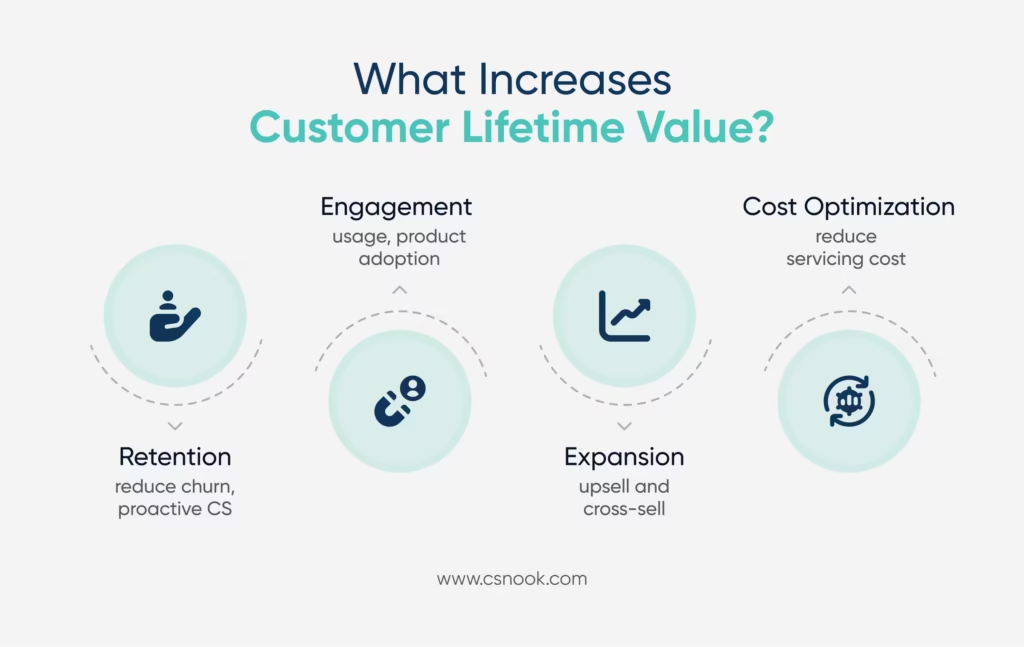
This is how CLV extends itself from being a financial metric to also being a necessary customer success metric as well.
How Businesses Use CLV
CLV becomes powerful when it is more than just dashboards and becomes the driver of decisions.
Smarter Customer Acquisition
Companies like Amazon famously invest heavily in acquisitions because they understand long-term value. Their purpose is to optimize for repeat behavior.
If the CLV of a business is ₹50,000 and its acquisition cost is ₹5,000, the math works.
But if there is no CLV, then the same ₹5,000 of acquisition cost can feel expensive.
Prioritizing High Value Customers
Not all customers necessarily contribute equally to a business. For a SaaS B2B company, for instance, small accounts can have less CLV, and enterprise accounts can have a high CLV.
Both cannot be provided with the same services. This means that focus can be shifted accordingly –
- Enterprise clients require more onboarding efforts
- Each client must have a dedicated customer success manager
- They must also have proactive engagement strategies
This is where systems like CSNook come in. They don’t help in CLV calculation but influence it by helping teams track customer health signals, engagement, and lifecycle workflows.
Reducing Churn
No matter the duration of the relationship with a customer, the chances of churn are always there. In fact, certain high-churn segments can reach up to 24% annually.
According to the Harvard Business Review Report, acquiring a new customer is 5 to 25 times more expensive than retaining those that are already associated with your business.
It is, hence, necessary for businesses to focus on retention because it significantly increases CLV.
Today’s customer success teams, hence, must keep note of signals by making sure to –
- Monitor usage patterns
- Identify drop-offs early
- Automate follow-ups and interventions
Having an understanding of just the formula is, hence, not enough for CLV calculation. Actions matter equally in the maintenance or improvement of CLV.
Common Mistakes in CLV Calculation
One may believe that calculating CLV is easy because all you have to do is put values in the formula. They would be wrong to think that, because many teams get CLV wrong in subtle ways and are often oblivious to the mistake that they are making.
Let us discuss some of these mistakes that one could potentially make.
Ignoring Customer Segmentation
All customers cannot have the same CLV number. Different segments of customers behave differently.
- Small and medium businesses vs enterprises
- Monthly vs annual plans
- High touch bs self serve customers
If a business does not segment its customers and work with them in accordance with their requirements, then its CLV number will just be average.
Overestimating the Customer Lifespan
Teams often assume customers will stay longer than they actually do. This inflates CLV and leads to risky spending decisions
Lifespan should be predicted based on actual churn data and should not be dependent on what you may “expect”.
Treating CLV as Static
Calculating the CLV once and then completely abandoning it is not the approach that one must follow.
CLV does not always remain the same and can fluctuate with –
- Pricing updates
- Product improvements
- Customer success efforts
- Market conditions
Ignoring Costs
For CLV calculation, focusing on just revenue is not enough. The true value of a customer is understood when the cost of serving that customer is also taken into account. This can be –
- Onboarding effort
- Ongoing support
- Discounts and incentives
Different customers provide profitability on the basis of how much resource incentive they receive. Teams should hence look further than the lifetime value; they should also pay attention to customer profitability.
By doing this, they can avoid over-investing in high-maintenance accounts and instead focus on those accounts that can provide more value and won’t even take up a lot of the team’s time.
Not Connecting CLV to Action
CLV is of no use unless it helps you make decisions. Knowing that a customer is “high value” does not mean anything when –
- They are not prioritized
- No workflows are triggered
- No proactive engagement happens
CLV insights need to connect with execution. Doing that is something many teams struggle with, especially when they only rely on spreadsheets.
To Conclude
CLV calculation is not about getting the perfect number. It’s about getting a useful direction.
How to start?
- Calculate a baseline CLV
- Segment your customers
- Identify what drives retention and expansion
After this identification, you can add in relevant systems and processes that improve these drivers of retention. Because at the end of the day, CLV is not just a metric you calculate, but a result that you build.
Common Questions
How does CLV calculation help customer success teams scale without chaos?
CLV calculation helps customer success teams prioritize high-value customers and allocate resources more strategically. Instead of treating every account the same, teams can focus on proactive engagement, onboarding, and retention workflows where long-term value is highest. Workflow software supports this by automating touchpoints and reducing manual effort.
Why is CLV calculation important when implementing customer success workflow software?
Customer lifetime value provides clarity on which customers deserve structured workflows and proactive management. When teams understand lifetime value, they can design onboarding journeys, adoption workflows, and retention strategies accordingly. Workflow software then ensures these processes run consistently, preventing scattered efforts and improving long-term customer relationships.
How can workflow software improve CLV calculation accuracy?
Workflow software improves CLV accuracy by centralizing customer interactions, engagement data, and lifecycle milestones. When customer success teams track onboarding progress, usage patterns, and renewal signals in one place, they gain better insights into retention and expansion behavior, which directly influences more realistic CLV estimates.
What role does automation play in improving CLV calculation outcomes?
Automation helps customer success teams respond to early warning signals such as reduced engagement or delayed onboarding. By triggering timely workflows, automation prevents churn and improves customer retention. Since retention directly increases customer lifespan, automation indirectly strengthens CLV outcomes and supports scalable customer success operations.
How can customer success teams use CLV calculation to prioritize workflow strategies?
Customer success teams can segment customers based on CLV and design workflows accordingly. High-value customers may receive personalized onboarding and proactive check-ins, while lower-value segments benefit from automated journeys. This structured prioritization reduces chaos, improves efficiency, and helps teams scale customer relationships sustainably.