
What looks like the end of a successful sale is, in reality, the starting point of a much larger journey. This is where the role of a customer success manager (CSM) comes in.
While the sales team celebrates the win, the CSM has to think of the steps ahead.
- How will this customer actually gain and realize the value of the product?
- What could be the potential obstacles that might emerge in the first 30 days?
- Who in their organization needs guidance to adopt the new system?
Unlike a contract, success cannot be written on paper. It has to be delivered, nurtured, and measured in outcomes.
It is the CSM and their team that help ensure that what was promised to the customer actually becomes a reality.
After everything is finalized with the sales team, the customer’s experience is in the hands of the customer success teams, who become the first point of contact. It is the manager of customer success who turns –
- Onboarding into momentum
- Adoption into habit
- Engagement into strategic partnership
Customer success goes beyond metrics and dashboards; the CSM’s responsibilities also include having skills like human judgment, empathy, and a sense of proactive decision-making.
This article aims to understand the journey of a CSM and the role they play in refining the customer’s journey.
Understanding What a Customer Success Manager Does
Before delving deeper into the duties of a customer success manager, let us first understand who they are.
A CSM is a post-sale professional who has to ensure that the customers achieve meaningful outcomes with a company’s product or service. Their focus is on what happens after the deal is made, and that is to help customers extract real value after the purchase.
- They guide customers through the early stages of product usage.
- Help them overcome challenges that they might face while adopting the product.
- Work with them over time to ensure the product continues to support their goals.
The job of a CSM is to maintain relationships and monitor the customer. This is just the surface-level responsibility. In reality, this role is much more complex and dynamic than it may seem. The company makes certain promises to its customers, promises of –
- Greater efficiency
- Improved results
- Smooth workflows
- Better insights
The CSM’s role is to ensure that the fulfilment of these promises is evident. As per reports, they are expected to not just come with more opportunities for sales but also identify and drive expansion revenue.
To do this, they connect three necessary pieces, and they are as follows.
Understanding the Customer Goals
Customers’ goals are not always obvious. For instance, a marketing team adopting a platform may want better campaign performance, while leadership might be focused on revenue attribution.
The CSM needs to understand and uncover these priorities so that the customer can use the services at its full potential.
Being a Product Advocate
Customers should not be left on their own to wander and understand the product or service. CSM, with their detailed knowledge of the product, can guide the customer towards the right workflow if they know which product feature can solve which problem.
Navigating Internal Workflows
Operators act as the internal advocates of the company. If a client struggles with a feature, requests a capability, or faces friction during adoption, the CSM often carries that context back to product, support, or engineering teams.
The three pieces are different yet interconnected. The conversations around the three, however, could vary widely for the customer success manager.
One conversation might be around helping a customer refine their workflow. The other might involve collaboration with the product team to explain how a particular feature is being used in the real world.
Hence, CSM is not just responding to the questions or resolving the problems. They are also –
- Decoding signals
- Guiding customers towards a better outcome
- Ensure that progress does not become stagnant for a long period of time
Following the Customer Journey Through a CSM’s Lens
Customers know their destination, and the CSMs provide them with the best route. And that journey truly begins during the first major stage of the relationship: onboarding.
Onboarding: Setting the Tone for Success
Onboarding is the stage that determines how the entire relationship of the company and its customers will unfold. Yes, it is the customer success manager’s responsibility to explain how their platform works. But now it has been established that their job is more than that. They have to provide such clarity that any sort of further confusion is avoided.
Some of the aspects of this include –
- Firstly, align with the objectives. Different stakeholders within the customer’s organization may have different expectations from the product. By clarifying these priorities promptly, the CSM ensures that onboarding leads to meaningful outcomes rather than generic training.
- They create early wins. When customers experience a tangible benefit, especially in the early stages, their confidence in the product increases.
- They also introduce structure during this phase. Since every organization is different, onboarding plans often need to be adapted. A startup with a small team may need fast, practical guidance, while a large enterprise may require a more coordinated rollout across departments.
When the onboarding base is strong, further building of customer experience gets smoother.
Adoption: Turning Usage Into Habit
Adoption is where many customer relationships quietly stall.
Teams may complete the setup process but might use the product occasionally. In other cases, they may rely on a single feature while being oblivious to the capabilities that could actually provide them even more value.
It is the CSM’s responsibility to guide the customer in utilizing the product fully and help them identify the unexplored opportunities to deepen engagement without being too pushy.
Understanding customer patterns and behaviour is one of the important skills that a customer success manager must possess.
A customer could be confused because they might not be able to understand the workflow, or they were not aware of the benefits of a certain feature or product.
A CSM subtly helps the product gradually be a part of the customer’s routine by providing them with –
- Guidance
- Coaching
- Periodic check-ins
Engagement: From Product Use to Strategic Partnership
Post the adoption stage, the customer has become comfortable with the product, and with that, the CSM’s role also begins to evolve.
Conversations go beyond basic operational questions and turn into discussions about goals and performance. The customer success manager becomes more like a strategic partner rather than being a product guide.
Guidance turns into structured interactions like business reviews and strategy sessions. What is discussed through these meetings is –
- Review of progress
- Highlighting areas of success
- Exploration of opportunities
As the relations turn collaborative, customers don’t just rely on CSMs for product knowledge, but also for insights on –
- Industry practices
- New features
- Potential strategies that could help improve results
Retention: Sustaining Value Over Time
While retention is generally considered to be one of the milestones of the customer journey, it is also the result of everything that happens before it.
When customers are given value throughout their journey, the likelihood of uncertainty at the time of renewal is reduced. At this point, the customer starts viewing renewals as a natural continuation of a productive relationship.
Retention is less about persuading customers to stay and more about ensuring they continue to see meaningful value over time. When that value is clear and consistent, the partnership tends to sustain itself naturally.
Skills That Make a Customer Success Manager Exceptional
A CSM’s role is a combination of relationship management, strategic thinking, and operational awareness. In order to successfully guide the customers, CSMs rely on a mix of interpersonal and analytical skills. Apart from those that have already been discussed with the stages, let us now discuss some other skills that are also necessary.
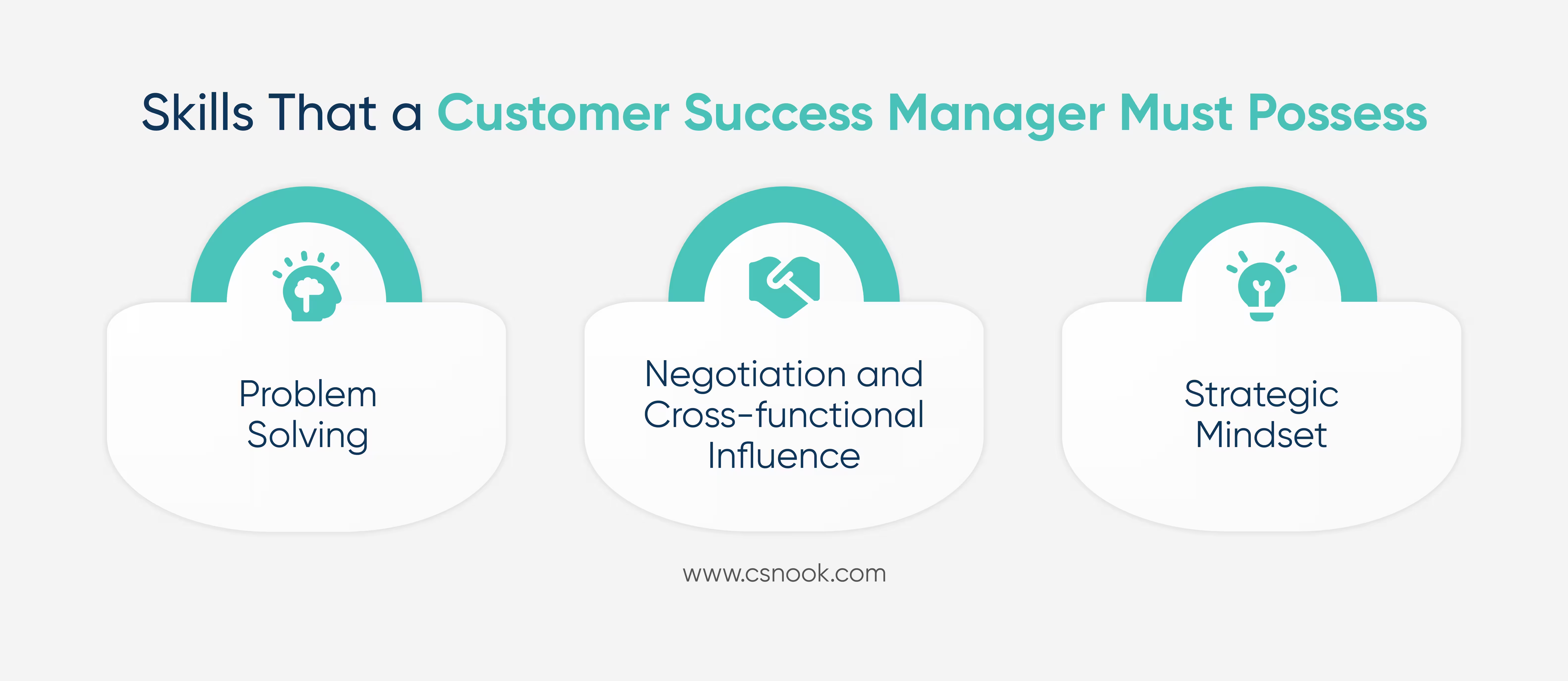
Problem-Solving in Dynamic Situations
Customer environments are rarely alike. What may work for one organization may not necessarily work for the others. This is why strong problem-solving becomes a necessary skill for customer success managers so that they can-
- Figure out the root cause of the challenges faced during adoption
- Suggest practical solutions that align with the customers’ processes
- Adapt recommendations when situations change
Negotiation and Cross-Functional Influence
No team can operate in isolation, and this is also applicable to the customer success teams. They eventually have to collaborate with product, support, sales and leadership teams to ensure all the customer requirements are addressed and fulfilled.
In many situations, they will have to –
- Coordinate internally to make product improvements and even fix bugs.
- They must align customers’ expectations with what the product actually provides.
- Coordinate with the other teams to resolve issues.
Strategic vs Reactive Mindset
The way CSMs approach problems creates a huge difference. The way to tackle issues can be either average or exceptional.
There are two common approaches: reactive and proactive.
A reactive approach involves –
- Waiting for the customers to report the issue
- Addressing the issues when it is too late and when everything becomes urgent
A proactive and strategic approach, on the other hand, involves –
- Identifying risks early
- Initiating conversations before the problems start to escalate
- Providing long-term solutions instead of momentary small-term fixes
This provides momentum to the entire journey, not just for the customer but also for the customer success manager.
This is where customer success software comes into the picture, where data and skills directly translate into outcomes. The aim of bringing these skills to practice is to retain customers and ultimately increase business revenue.
According to Forbes, about 80% of a company’s future revenue often comes from just 20% of existing customers. This is why CSMs are expected to focus heavily on retention and expansion rather than only acquisition.
Additionally, many businesses are turning subscription-based, and want the customers to either stay or keep coming back. This is because they want to see value month after month.
As per Forbes, the International Data Corporation predicted that 53% of all software revenue would come from subscriptions. Revenue here is not limited to sales; it is also earned continuously through retention, adoption and expansion.
Challenges Customer Success Managers Face
Until now, we have seen how the role of a customer success manager is impactful and how they help customers at different steps of their journey. However, this does not mean that the CSM’s own journey is smooth. They have their own obstacles that they face.
Some of the common challenges include –
Managing Multiple Accounts Simultaneously
CSMs often handle several customers at different stages. Some could be onboarding, some adopting features, and others approaching renewal.
Deciding where attention is needed most becomes a constant balancing act.
Handling Low Adoption or Disengagement
Sometimes customers stop actively using the product despite having access to useful features. This is when CSMs are expected to identify the root cause of the issue and re-engage the customer.
Navigating Stakeholder Changes
A champion who initially supported the product may not always remain an ally of the company. There will come a point where they may want to leave. When this happens, CSMs have to rebuild relationships with new stakeholders and re-establish the product’s value.
Conclusion
Customer Success Managers play a crucial role in shaping how customers experience a product after the sale. Their work influences whether customers successfully adopt the product, continue using it, and eventually renew or expand their relationship with the company.
In practice, their impact appears in many ways:
- Guiding customers through onboarding and early success
- Encouraging deeper product adoption over time
- Acting as a bridge between customers and internal teams
- Identifying risks before they lead to churn
- Discovering opportunities for long-term growth
As businesses increasingly rely on subscription and recurring revenue models, these responsibilities become even more important. A CSM ensures that value is continuously delivered, helping transform one-time buyers into long-term partners.
Common Questions
What metrics do customer success managers track to measure customer health?
Customer success managers monitor metrics that indicate whether customers are gaining value from a product. Some of the common indicators include product usage frequency, feature adoption rates, support ticket trends, renewal likelihood, and Net Promoter Score (NPS). These signals help CSMs identify risks early and take proactive steps to maintain engagement.
At what stage of the customer journey does a customer success manager become involved?
A customer success manager ideally must become involved immediately after a sale is completed. Their role begins with onboarding and continues throughout the customer lifecycle, including adoption, engagement, renewal, and expansion. By staying involved over the long term, CSMs ensure that the customers are able to achieve their goals in accordance with their needs.
How do customer success managers identify early warning signs of customer churn?
CSMs look for signals such as declining product usage, reduced login frequency, unresolved support issues, missed success milestones, or lack of engagement from key stakeholders. These patterns often indicate that customers are not receiving expected value, which allows the CSM to intervene early and restore momentum.
How do customer success managers collaborate with product and sales teams?
Customer success managers act as a bridge between customers and internal teams. They share feedback about product usage, common challenges, and feature requests with product teams. With sales teams, they provide insights on expansion opportunities, helping ensure that growth conversations are based on real customer value.
How does the work of a customer success manager influence product development?
As CSMs interact closely with customers, they gather valuable insights about real-world usage. They identify recurring pain points, missing features, and workflow challenges. When shared with product teams, this feedback helps shape product improvements, ensuring future updates better align with customer needs and expectations.