Customers are never lost overnight, nor are they lost due to a single reason. It is never sudden, and there is no clear warning sign.
The customer just slowly drifts away and then eventually leaves.
- Logins become less frequent
- They stop using features actively
- Conversations go quiet, almost as if you are getting ghosted
If a churn comes off as a surprise, then it means that there were signs that you were oblivious to, or something wasn’t acted upon on time.
The average customer churn rate across industries is 18-20%.
Customer retention is not about being able to stop the customer from leaving at the last moment. It is about ensuring that they never reach that point in the first place.
This is where a customer success team steps in. They come in as a system that ensures that customers succeed consistently.
A good customer success manager does not chase churn. Instead, they design such systems that make the customer feel valued, engaged, and help them grow with time.
Businesses must take that shift. The switch from managing customers to enabling success at scale. Let us discuss this in more detail.
Why Customer Retention Matters More Than Ever
As per the research from PwC and Gartner, 73% of customers believe experience is one of the important factors that influences their loyalty, even more than price.
Loyal customers aren’t just the ones who stay, but also the ones who are willing to spend. Retention is hence not just about keeping customers. It is also about deriving more customer lifetime value from the already existing customers without having to restart the growth cycle again and again.
Retention Starts Earlier Than Most Teams Think
Customer retention is not something that should be worked on at the last stage. It is something that must be paid attention to just as the signals start to appear.
Ideally, retention should start the moment the customer says “yes” to your product.
Moreover, customers don’t churn because of just one bad experience. They churn because value was never clearly realized in the first place.
This is why onboarding is one of the most important retention levers.
Strategies That Customer Success Teams Can Follow
Strategy 1: Build Structured Onboarding For Early Wins
It is the experience of value that locks a customer in first. Understanding everything about the product or service comes secondary.
The faster someone reaches their “aha moment,” the more likely they are to stay.
Let us take the example of Slack. They are like a powerhouse of retention and not just because of the features they offer, but because of the quick and clear communication skills of their team. By getting a team to send 2000 messages through a structured onboarding tool, they managed to attain a retention rate of 93%.
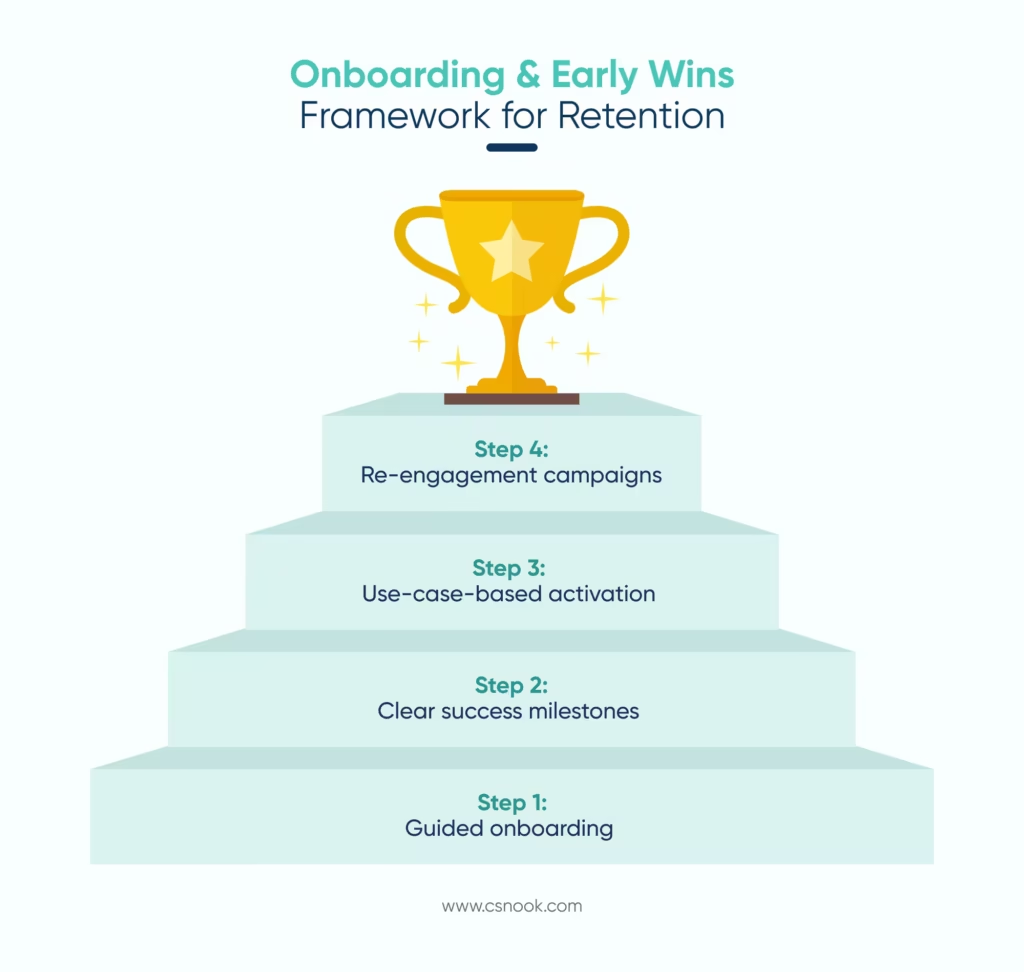
Customer success teams can generate momentum early on when they focus on –
- Guided onboarding journeys
- Clear success milestones
- Use-case-based activation
This is why a system becomes necessary. Lack of system and structure leads to inconsistency, which is highly unlikable and eventually leads to churn.
Strategy 2: Monitor Customer Health Before It’s Too Late
Customers drop subtle hints before they churn. Some of the common signals that should be caught on are –
- Declining usage.
- Missed milestones.
- Reduced engagement.
Data is not the issue here; the pain point here is that of a lack of clarity.
Organizations that effectively use customer analytics outperform competitors in retention and engagement. Customer success teams that succeed in reducing churn are not the ones who wait for customers to complain.
These teams continuously keep track of the customer health and are ready to fight or flee upon it early.
This is where platforms like CSNook fit naturally into the workflow. They help teams move from scattered signals to structured visibility across accounts. This way, instead of reacting to problems, teams can prioritize accounts that actually require attention.
Strategy 3: Shift From Reactive Support to Proactive Success
The role of customer support teams is to answer questions. The role of customer success teams, on the other hand, is to prevent the arising of questions in the first place.
Instead of waiting for a customer to say, “I’m stuck,” what the proactive teams do is –
- Check in before critical milestones
- Share best practices regularly
- Recommend next steps based on usage
HubSpot is a great example of this. With help of its resources, playbooks, and proactive guidance, they ensure customers continuously discover new value. Instead of waiting for a support ticket, their system auto-generates a customer health score.
The impact of this is that customers are not just there to stay but also to expand.
Strategy 4: Personalization at Scale
Customers want to see relevance and be able to relate with the product or service that is being provided to them. Personalization, hence, helps in scaling but not when done manually.
This is where many teams struggle. They can potentially make two mistakes as they either –
- Over-automate and lose the human touch
- Or stay manual and become inefficient
The best approach however, is to stay in the middle and create a balance. By using –
- Segmentation
- Lifecycle stages
- Behavior-based triggers
teams can deliver personalized experiences without overwhelming themselves.
For instance:
- New customers are pushed to onboard
- Power users are recommended for advanced features
- Inactive account are pulled with re-engagement campaigns
According to McKinsey, personalization can reduce acquisition costs by up to 50% and increase revenue by 5–15%
Strategy 5: Turn Feedback Into Action and Not Just Data
Collecting feedback is an easy yet necessary task. But acting on those feedbacks is the point where most teams get stuck.
Customers do not look for perfection when they feel heard. It is the simple practices that make a big difference-
- Closing the loop on feedback
- Communicating product improvements
- Showing customers how their input shaped decisions
Let us take the example of a company called Notion to understand this better. Their community-driven feedback method has helped them continuously refine the product while strengthening customer loyalty. This is because when customers feel involved, they’re far less likely to leave.
Strategy 6: Create Expansion Opportunities Through Value
Retention is also about creating and deepening relationships. Customers want value and if that is delivered, they help you expand.
Customer success teams play a key role here by –
- Identifying upsell moments based on usage
- Introducing features aligned with goals
- Guiding customers toward more advanced outcomes
This approach shifts the conversation from selling to enabling. When done right, it makes growth feel like progress and not something that is forced.
Common Mistakes That Hurt Customer Retention
Even well-intentioned teams fall into the trap of making the following mistakes –
- Focusing only on churned customers – By the time someone churns, the opportunity is already lost. Prevention matters more than recovery.
- Overloading customers with features – More features do not mean more value can be derived. It is the clarity that beats complexity. Data shows that up to 97% of user churn is silent due to UX frustration.
- Ignoring silent churn signals – Not all churn is loud; some customers just slowly disengage.
- Treating all customers the same – Different segments need different strategies because uniform experiences rarely work.
To Conclude
Strong customer retention doesn’t feel forced.
It looks like –
- Customers reaching value quickly
- Teams being aware of the accounts that need attention
- Conversations driven by insight, not guesswork
- Growth that takes place without constant pressure
In other words, customer retention is a byproduct of a well-designed system.
Common Questions
What are the most effective customer retention strategies for SaaS companies?
For customer retention, teams should focus on onboarding, proactive engagement, personalized experiences, continuous monitoring of customer health, and actionable feedback loops. SaaS companies benefit when these approaches help customers quickly realize value, stay engaged, and expand their usage, reducing churn and increasing long-term revenue.
How can customer success teams prevent churn before it happens?
Customer success teams prevent churn by tracking engagement metrics, identifying early warning signs like declining usage, and proactively guiding customers toward value. Regular check-ins, milestone tracking, and timely recommendations ensure customers stay on track, fostering loyalty and reducing the risk of silent disengagement that often leads to churn.
Why is onboarding critical for customer retention?
Onboarding sets the foundation for customer retention by helping users experience early wins and reach their “aha moments” quickly. Structured onboarding guides customers through product features, milestones, and use-case scenarios, ensuring clarity, reducing confusion, and increasing engagement, which makes customers more likely to stay and derive continuous value.
How does personalization improve customer retention?
Personalization improves retention by delivering relevant experiences tailored to customer behavior, lifecycle stage, and goals. By using segmentation, automated triggers, and tailored recommendations, teams can engage new users, re-engage inactive accounts, and empower power users, creating value-driven interactions that strengthen loyalty and encourage long-term retention.
What common mistakes reduce customer retention, and how can they be avoided?
Common retention mistakes include overloading customers with features, ignoring silent churn signals, treating all customers uniformly, and focusing only on already-churned users. Avoiding these errors requires segmenting customers, acting on early warning signals, prioritizing prevention over recovery, and designing clear, structured systems that consistently deliver value across the customer lifecycle.