
What if the key to better customer outcomes isn’t in your product roadmap or customer success playbook—but in how your own team feels about coming to work?
While B2B executives commonly follow specific customer health metrics, use rates and overall retention, there is often a disconnect between the metrics executed on the customer side versus what’s happening within their organization.
The truth is that disengaged employees do not create strong relationships with customers; they tend to just check boxes off, fail to notice signals, or continue with the motions but are not engaged.
The metric which identifies this risk is known as employee net promoter score (eNPS). It is a simple question that has great meaning: “How likely are your employees to recommend you as a great place to work?” The results of this survey can serve as an indicator for everything from customer satisfaction to future revenue growth.
In this article, we will explore the definition and measurement of eNPS as well as why it is more important than you may think.
Understanding Employee Net Promoter Score
eNPS measures whether workers are encouraged to suggest your company to their friends. This is a simple and effective approach to understanding how satisfied workers are and how engaged they are with their jobs.
The eNPS originated from the NPS (Net Promoter Score) developed by Bain & Company and Fred Reichheld in the early 2000s. Originally, the NPS was used to measure how loyal customers were. However, human resource leaders have adapted this framework for employees so that they can gather information about their employees’ experiences.
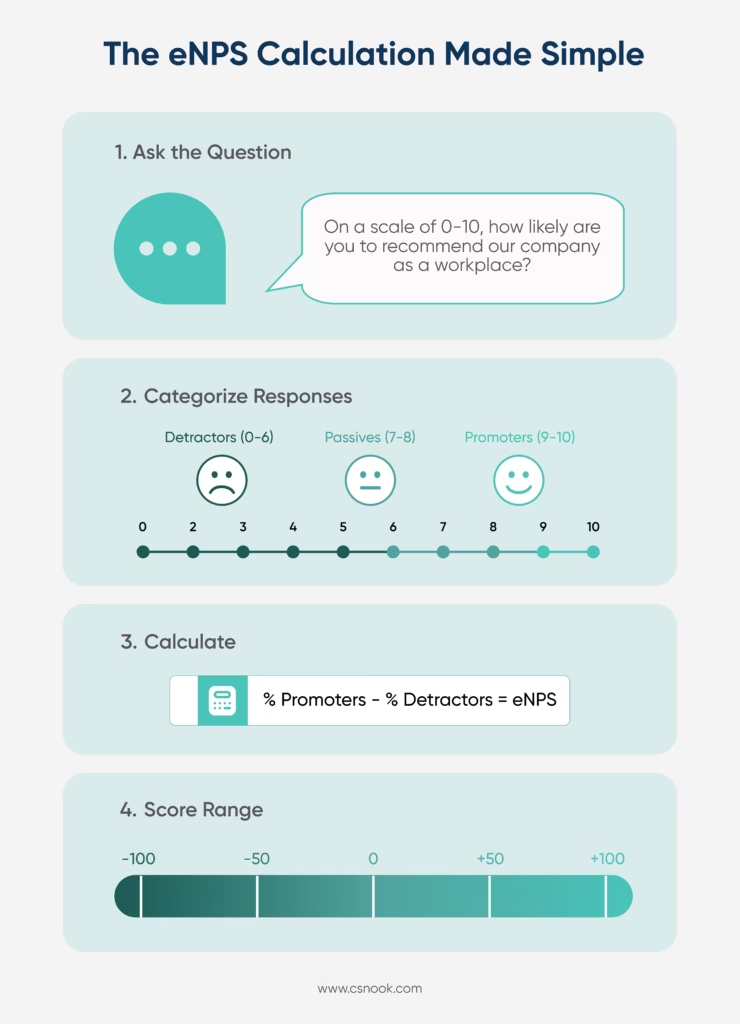
The measurement is straightforward. You ask employees one core question:
“On a scale of 0 to 10, how likely are you to recommend our company as a great place to work?”
Based on their responses, employees fall into three categories:
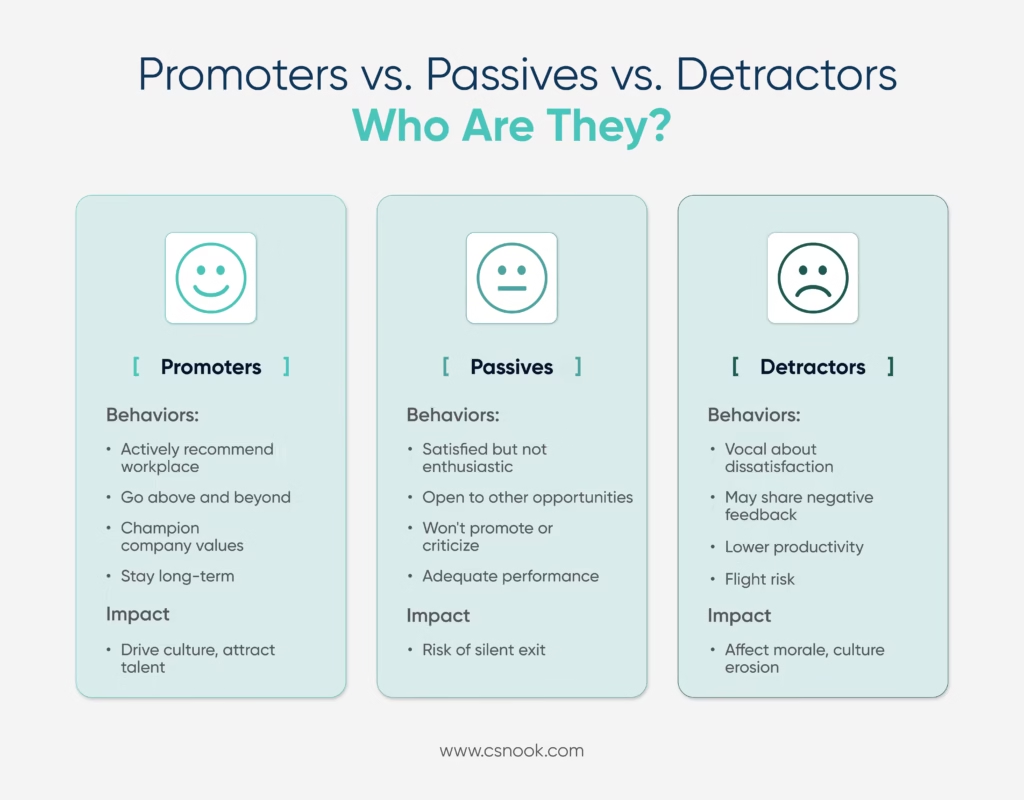
- Promoters (9-10), who actively support it.
- Passives (7-8), who don’t dislike it but won’t recommend it to others
- Detractors (0-6) are unhappy employees whose dissatisfaction can impact morale and culture.
What makes eNPS valuable is that it is very simple. It is easy to give out, quick to complete, and gives you a numerical score so that leadership can keep track of the scores over time. It is an easy way for organizations to get a sense of how their employees feel about them.
How to Calculate Employee Net Promoter Score
The eNPS is easy to calculate, and that’s part of the reason why it has been adopted by so many companies.
Start by sending out the core question in a survey to your employees. Once the surveys are completed, you can sort them into categories based on their scores.
Next, calculate the percentage of each group based on the total respondents.
Here’s the formula:
eNPS = % Promoters – % Detractors
Passives aren’t included in the calculation, though they’re still important to understand.
The eNPS score will range from -100 to +100. A score of -100 indicates that every employee in the company is a detractor, and vice versa for a promoter.
Here is an example:
Suppose you did a survey of 100 employees. You have 50 as promoters (50%), 30 as passive respondents (30%), and 20 as detractors (20%).
Your eNPS calculation: 50% – 20% = 30
That’s a solid score, indicating more employees are engaged and willing to advocate for your workplace than those who aren’t.
It is easy to track trends, measure performance between departments, and compare against industry averages due to the ease of use of this calculation.
What Makes a Good Employee Net Promoter Score?
Understanding your result requires some context. The definition of “good” is based on your industry, company size and growth stage. There are, however, general standards that you may follow to help you assess your score.
- 0 or above — You have more promoters than detractors. (This is the lowest acceptable score).
- 10 – 30 score — Your employees are generally positive about working there.
- 30 – 50 score — Your business is experiencing a high level of engagement and employee satisfaction.
- 50 or above — You are rated as a top tier. Employees are true advocates for your business.
- Negative scores — Red flag. More detractors than promoters signal widespread dissatisfaction that needs immediate attention.
But what’s important is: A score of 20 that’s trending up is better than a score of 40 that’s trending down
The actual value is in understanding the information your score provides about your workplace, and how you are going about improving it, not in reaching any specific value.
Why Employee Net Promoter Score Matters in B2B
Did you know that there’s an actual relationship between employee engagement and customer satisfaction. Afterall, happy employees will put in more efforts to keep customers happy.
When employees do not engage with their work, it can be clearly measured through their interactions with customers. Missed signals, inconsistent service, and longer response times. In B2B business environments where relationships dictate revenue, gaps in performance can be costly.
The research backs this up. Companies with highly engaged employees see a 10% increase in customer ratings. The Institute of Customer Service found that a one-point increase in employee engagement leads to a 0.41-point increase in customer satisfaction.
Why does this matter for SaaS companies specifically?
Customer success hinges on building human connections. Your CSMs, account managers and support teams represent your organisation in regard to interpreting customer needs, identifying churn indicators and encouraging expansion opportunities for your customers.
When teams are engaged in creating successful customer experiences, they can do more than just execute their playbooks; they can see what is not written down and preemptively reach out to help prevent problems before they occur. They treat their customers like partners (not just as another account).
Your customers can sense when your team is disengaged. Interactions with them turn into transactional behavior, renewals feel more like negotiations, and, quietly, your overall retention decreases.
Even if you have the best product or customer success strategy, if they are not engaged, then execution can’t happen. Employee net promoter score (eNPS) serves to provide you with an early view into this risk prior to it impacting your bottom line.
How to Use Employee Net Promoter Score Effectively
Collecting scores is only the starting point. The real value comes from what you do with the data.
Ask Follow-Up Questions
The eNPS provides insight into employee sentiment, but does not clarify the reasons behind it. As such, a score of 10 or 6 needs explanatory context.
Add an open-ended question to your survey: “What’s the main reason for your score?”
This qualitative feedback is where you will identify the pattern of response. For instance, you might discover that employees who rated you as a 10 all consistently reference strong leadership, while those who rated you a 6 referenced unclear career paths or lack of communication. These insights turn a number into a roadmap for action.
Track Trends Over Time
An individual survey is just one moment in time. Regular tracking over time gives you an idea of direction.
Measuring employee net promoter score on a quarterly or bi-annual basis allows you to see trends over not only over the entire company, but also by department, length of employment, location, or management level. A high overall score may hide some areas of disengagement that need to be addressed.
The goal isn’t perfection, it’s progress. A score moving from 5 to 15 over six months tells you something is working.
Close the Feedback Loop
Here’s an area where many groups fall short; they gather input, and no follow-through occurs.
Disclose findings to your organization’s members. Clearly outline both positives and negatives, while exhibiting how you’ll be changing from their input. When employees see their feedback lead to real action, trust builds. And trust is what turns passives into promoters.
Conclusion
The employee net promoter score is not merely an HR metric; rather, it’s a signal about the business itself.
The connection is straightforward: engaged employees create better customer experiences. They catch risks sooner. They sustain powerful relationships. They convert transactions into partnerships.
Begin with measuring your results and monitoring their trend over time and asking questions related to why instead of just what. Most importantly, act on the data you collect. In B2B, where relationships drive revenue, your team’s engagement is not separate from customer success. It is the bedrock of it.
Common Questions
What is the difference between eNPS and NPS?
NPS gauges customer loyalty by measuring how likely one is to refer others to a product or service. Employee Net Promoter Score gauges employee loyalty by evaluating how likely one is to refer others to their place of work.
How often should companies measure employee net promoter score?
The majority of companies will quantify and analyze their eNPS quarterly or twice a year to identify key trends, while minimizing this type of survey fatigue with their employees. Fast-growing companies may use monthly pulse checks, while slow-growing companies may use annual surveys.
Can employee net promoter score predict employee turnover?
Yes. Research has proven that employees with low eNPS will often leave within six to twelve months of receiving a low score on their success measures (deterrents); and monitoring your employee net promoter score enables you to identify and take action on these employees for the purpose of proactively preventing their resignation.
What questions should follow the main eNPS survey question?
Ask one open-ended question: “What’s the main reason for your score?” This captures qualitative insights explaining the rating. For detractors, ask “What would make this a better workplace?” These follow-ups transform scores into actionable feedback for improvement.
How does employee engagement affect customer satisfaction in B2B companies?
Research shows a direct correlation: companies with engaged employees see 10% higher customer ratings. In B2B, where relationships drive retention, engaged teams deliver proactive service, catch churn signals earlier, and build stronger client partnerships—directly impacting customer satisfaction and revenue.


