Winning a customer used to be the finish line.
Today, it is just the starting point.
Modern businesses, especially SaaS and subscription companies, no longer grow simply by acquiring customers. They grow by keeping them, helping them succeed, and expanding those relationships over time. A sale may open the door, but long-term value comes from what happens after that.
This is the space where customer success (CS) operates.
It is not just about answering questions or fixing problems. It is about guiding customers so they consistently achieve meaningful results with a product or service. When done well, it turns adoption into habit, habit into value, and value into loyalty.
This article explores what client success really is, how it fits into the modern customer lifecycle, and why it has become a foundational driver of sustainable business growth.
What is Customer Success?
It is a structured way through which businesses ensure that customers are provided with meaningful outcomes with the help of their products and services.
They don’t wait for customers to face problems. Instead, the focus here is on guiding them towards value from the beginning itself.
In simple terms, CS teams are meant to answer a key question:
“Are customers really benefiting from what they’ve bought?”
This approach has become especially important in modern business models where revenue depends on long-term relationships rather than one-time purchases. If customers fail to see clear value, they disengage, cancel subscriptions, or move to competitors.
Client success exists to prevent that.
The Customer Success Function
To operationalize this approach, companies create customer success teams. They are dedicated groups that are exclusively responsible for –
- Monitoring customer engagement.
- Identifying risks early.
- Ensuring that customers continue to achieve their goals over time.
The focus here is not just on transactions, but the entire customer lifecycle.
Their responsibility is to ensure that customers move smoothly through critical stages such as onboarding, adoption, value realization, and renewal.
This means success teams often work across multiple signals, including –
- Product usage and engagement patterns
- Customer feedback and satisfaction data
- Support interactions and recurring issues
- Business outcomes customers expect to achieve
By analyzing these signals, the team can identify when customers are thriving and when they may be at risk.
What Customer Success Actually Does
In practice, client success teams act as a bridge between customers and the rest of the organization. Their role is to ensure that customers are not just using the product but are getting real, measurable value from it.
This can involve activities such as –
- Helping new customers successfully onboard and reach their first milestone
- Monitoring product adoption to ensure important features are being used
- Providing strategic guidance on how customers can achieve their goals
- Identifying early warning signs of churn and intervening proactively
- Highlighting opportunities for expansion when customers grow
In other words, customer success focuses on making sure the promise made during the sale turns into real outcomes for the customer.
When done well, this benefits both sides. Customers achieve their desired results, while businesses benefit from stronger retention, expansion opportunities, and long-term loyalty.
Why is it Essential?
Business models have evolved with time. In traditional models, revenue was recognized beforehand. The financial impact could be seen immediately after the sale was made.
Whether the customer stayed after making the first purchase was important, but it was not as structurally critical as it is today.
In the present-day scenario, the way businesses function has changed. They have become subscription-based and run on the recurring revenue model. Revenue here is generated over time. A customer who leaves after six months instead of three years dramatically changes the economics of the business.
It is because of this shift that certain new metrics have been introduced, namely –
- Customer retention rate
- Churn rate
- Net revenue retention (NRR)
- Expansion revenue
- Customer lifetime value (LTV)
It is not just sales alone that influences these metrics. The value of customer experience post-onboarding also plays an important role. Customer success has a major responsibility in making that possible.
Without a strong CS, businesses may experience what is commonly known as the “leaky bucket problem.”
The sales department brings new customers. When there is no continuous and structured engagement, the older ones may get abandoned and tend to leave.
Bringing new customers is one thing; maintaining those customers is another.
Growth becomes exhausting because teams are constantly replacing lost revenue instead of building on existing relationships. Customer success fixes this leak.
The Customer Success Lifecycle
Customers should not be seen through isolated touchpoints but as a whole, structured lifecycle. The different stages of this cycle include –
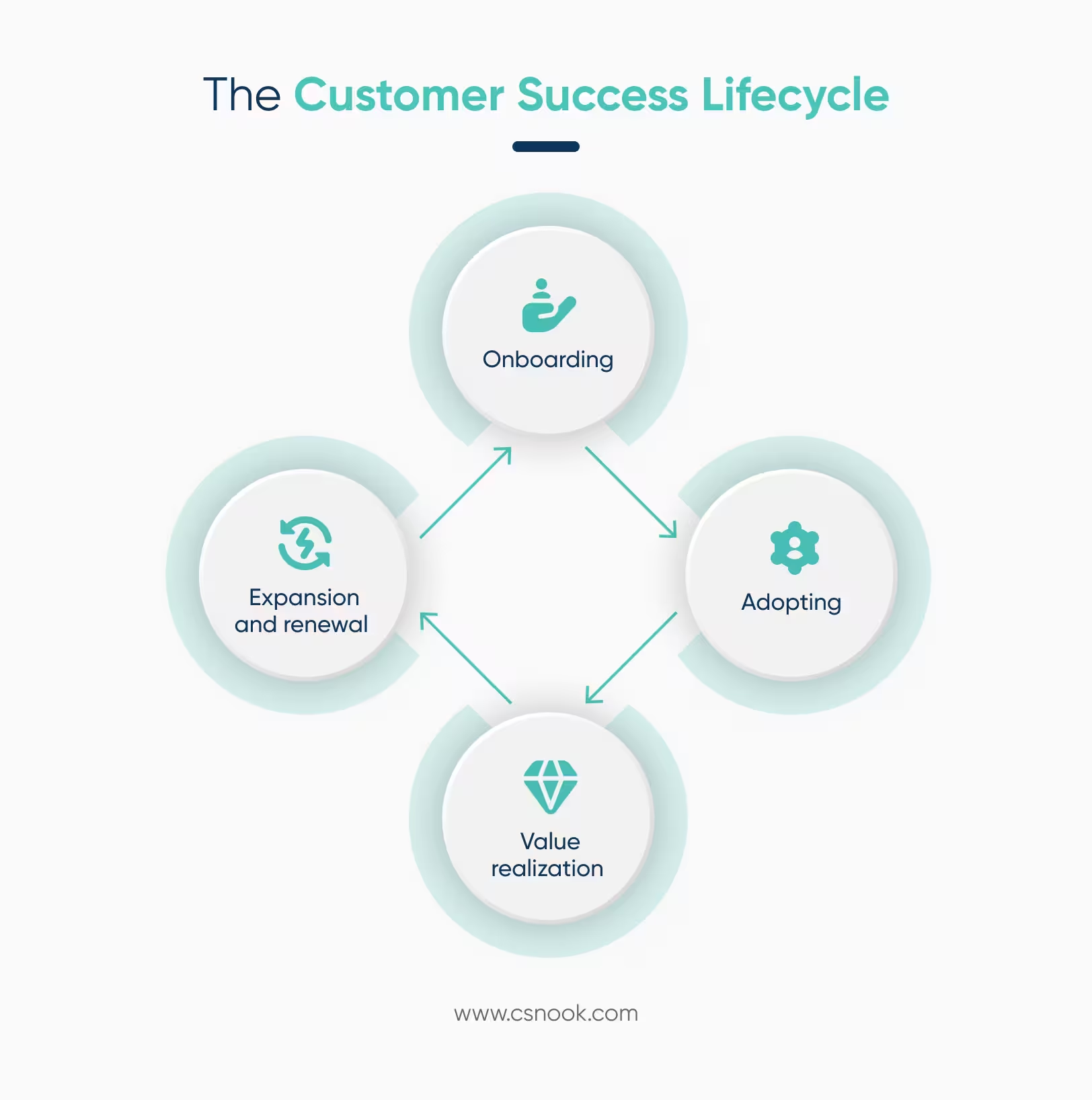
Onboarding: Building Early Momentum
A strong foundation means the building will be strong. Similarly, the onboarding phase determines the long-term path of the customer. It is because this is the stage where the customer evaluates whether they are making the correct decision or not.
Effective onboarding focuses on –
- Clear milestones
- Defined outcomes
- Time-to-value
- Stakeholder alignment
For instance, a B2B software company might define a 30-day onboarding plan that ensures customers complete specific setup tasks and achieve a measurable win before the first review call.
Pace builds confidence, and confidence leads to retention.
Adopting: Encouraging Habit Formation
Onboarding is just the beginning of the journey, adaptation is what moves the needle further. This is when the product becomes a part of the customer’s routine tasks.
Here, customer success teams monitor the user’s usage pattern to identify –
- Gaps in feature adaptation
- Product capabilities that are not utilized enough
- Engagement declines
If a CSM notices that a customer is only using basic features, they can introduce them to the advanced workflows that unlock greater value. The idea here is to urge the user to utilize the product and services to its fullest potential.
This is because adoption makes the user stick around, which drives retention.
Value Realization: Making Impact Visible
Customers should be fully aware of the impact the product has on their services. This may include –
- Performance dashboards
- Quarterly business reviews (QBRs)
- Outcome-based reporting
For example, instead of simply reviewing usage metrics, a CSM might just demonstrate how the product helped reduce the operational time by 20% or increase campaign efficiency.
When value is visible and measurable, renewal becomes logical rather than emotional.
Expansion and Renewal: The Natural Outcome
When the first three steps of the cycle are executed successfully, expansion and renewals come in naturally and do not have to be pushed on the user. It is important to note that renewal should be more of a continuation and not a negotiation.
If renewal conversations are tense or uncertain, the issue usually lies earlier in the lifecycle. Customer success ensures that each stage supports the next. This is why success teams play a major role in driving long-term growth as well.
Customer Success and Long-Term Growth: The Direct Connection
Retention Creates Stability
Retention is not only about preventing churn but also ensuring that revenue is continued and preserved. Leadership can become confident about their decisions when they know that renewal rates are high and predictable. This is also when hiring, expanding into new markets and product developments seem less risky.
Customer success directly influences retention by ensuring that customers clearly understand and experience value. Renewals become negotiable only when the value of the product is vaguely understood by the customer.
On the other hand, if the value is embedded in workflows and measurables, renewals become obvious.
Research highlights that when a customer’s experience is meaningful, and they receive genuinely improved outcomes, the likelihood of them staying with the company is almost 82%.
An example of this can be how Lingopie, a language-learning platform focused intensely on helping users achieve real progress rather than just increasing engagement metrics.
By focusing on client success, listening to customers, and delivering value, Lingopie reached a 79% of retention rate within four months.
Expansion: Turning Value Into Growth
Expansion revenue is one of the most important growth levers in modern businesses. This could be an –
- Upsell
- Cross sell
- Additional seats
- Upgraded plans
Imagine a growing fintech startup that initially uses your analytics platform for one department. Over time, as their customer base expands, they need more advanced reporting and additional user licenses.
If the customer success manager has maintained consistent strategic conversations, understands their roadmap, and tracks adoption metrics, the expansion conversation feels aligned.
Advocacy: Turning Customers Into Champions
Word of mouth marketing matters, and it’s usually the satisfied customers who talk.
- They write reviews
- They refer to peers
- They speak at events
- They are even willing to participate in case studies
Customer success plays an important role here because it helps build trust. A customer who feels guided, supported, and strategically aligned is far more likely to endorse your brand.
Advocacy lowers acquisition costs and strengthens brand credibility. In competitive markets, peer validation often affects buying decisions more than marketing campaigns.
It is not just the advocacy that matters. Customers are also champions in the sense that they provide success teams with real-world feedback about the products and services. They help in the identification of –
- Feature gaps affecting adoption
- Messaging misalignment from sales
- Workflow challenges that product teams overlooked
- Emerging expansion opportunities
Early Signal Detection Reduces Risks
Churn rarely happens without warning. Subtle signs and behavioural shifts are something that the success and support teams should be cautious about. These signs include –
- Declining usage
- Reduced engagement in meetings
- Slower response times
- Lower feature adoption
It is the role of customer success teams to keep a note of this behaviour. Instead of discovering dissatisfaction at the end moment, having a prior identification of patterns helps the teams take action beforehand.
The Difference Between Customer Success and Customer Support
Confusion between these two functions is common, but this confusion costs a lot.
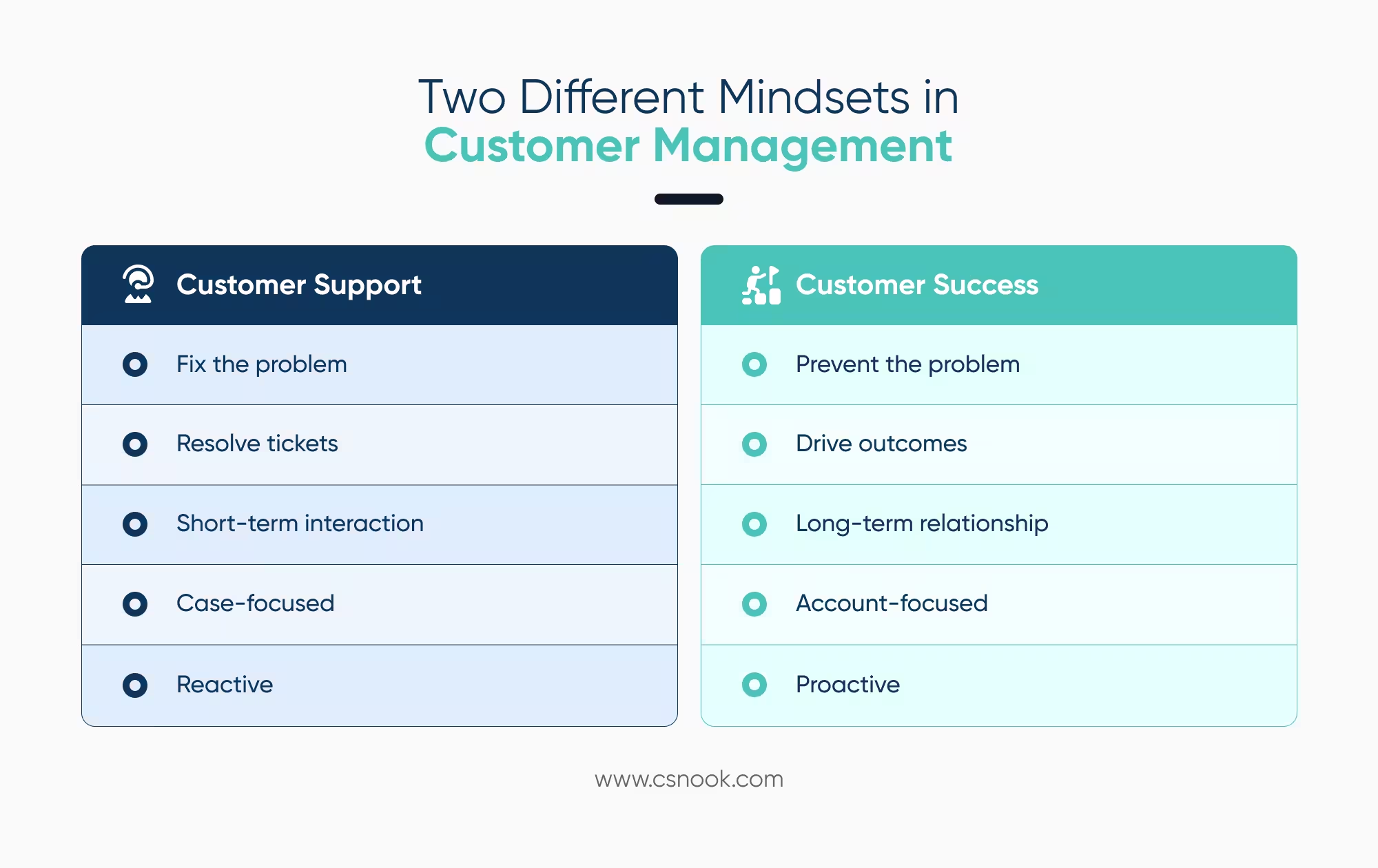
Customer support is reactive and issue-driven. Its main responsibility is to resolve problems quickly and efficiently.
Customer success, on the other hand, is proactive and outcome-oriented. It aims to ensure that customers are achieving ongoing value.
Metrics that are relevant and necessary for the support team include –
- First response time
- Ticket resolution time
- Customer satisfaction
Customer success metrics, on the other hand, typically include –
- Retention rate
- Net revenue retention
- Expansion rate
- Customer health score
- Adoption metrics
While support operates at the interaction level, success operates at a relationship level.
While the two are separate entities, they cannot exist in isolation and are dependent on each other to be able to function successfully. They work as a part of the same customer engine, with one aim to improve customer experience, retention and long-term growth.
How They Work Together
When the CS t and support teams work together, they fill the gaps that are left in the customer’s journey.
- Customer success teams firsthand see where the customer is struggling. These can be common errors, confusion and recurring bugs. This information is then further valuable to the success teams. Through this, CSMs can proactively address patterns before they become churn risks, tailor onboarding and training, and support customers strategically rather than starting from scratch each time.
- If the two teams work together, the customer wouldn’t have to bounce between the two. For this to happen, businesses should organize proper escalation paths. Highly technical issues can be raised with the support teams. Issues like complex adoption barriers, recurring obstacles, or strategic challenges are handed to the success team for proactive engagement.
- This coming together of two teams makes customers feel supported, which further boosts satisfaction and retention. This collaboration leads to fewer churns and a more stable revenue base.
- Support tracks short-term customer pain points, while success tracks long-term adoption and health. When this data is combined from both ends, for example, through shared CRMs or analytics tools, organizations get a holistic view of the customer journey.
Best Practices for Customer Success Teams
For both CSMs who are managing accounts and the leaders who are building the function, excellence in customer success comes from turning strategy into structured execution.
The following best practices help transform client success from a supportive function into a measurable growth engine.
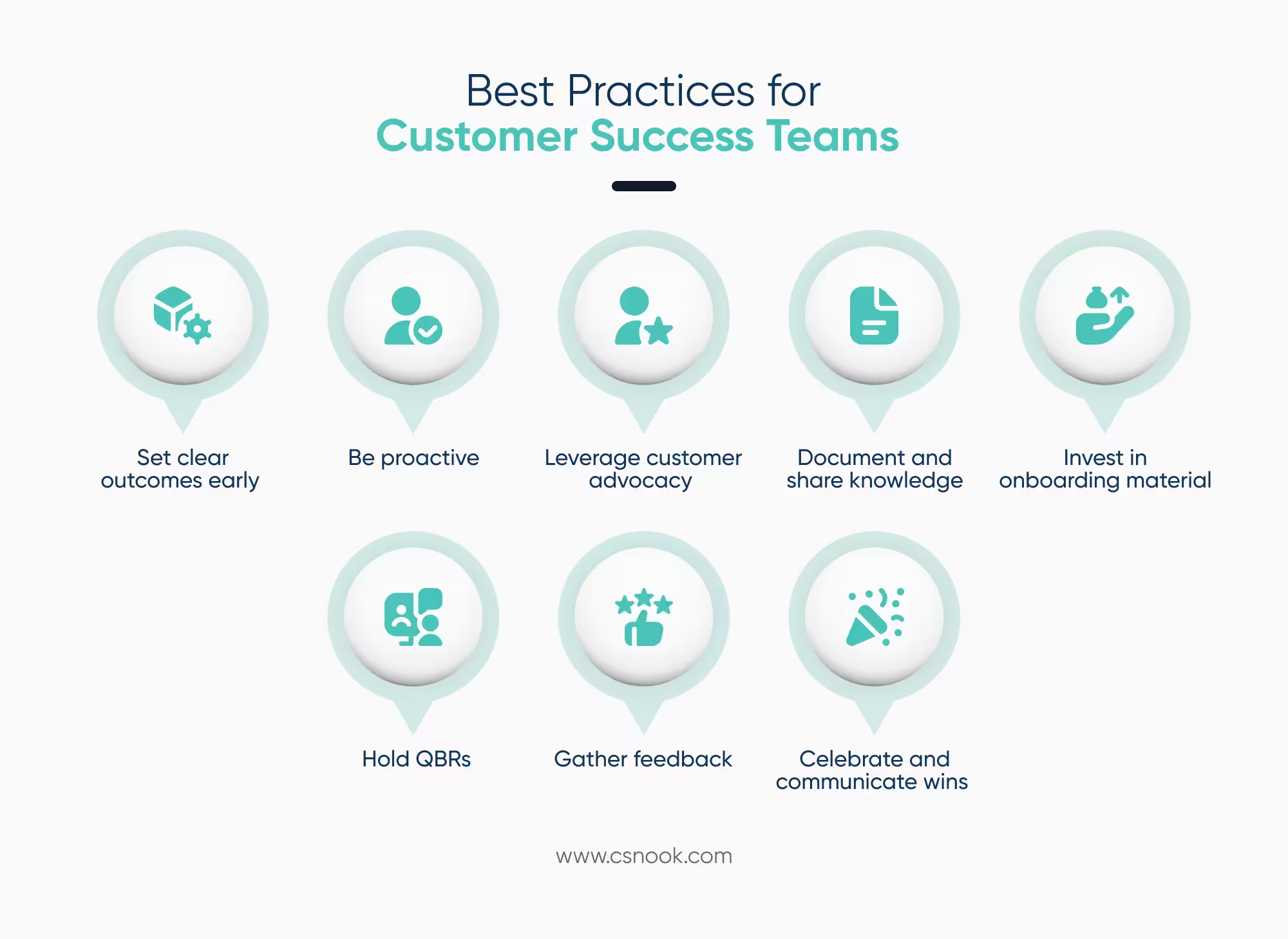
Set Clear Success Outcomes Early
The first step of engagement is having clarity of what success looks like for them and the business. Instead of using statements like “improve product usage,” they should align on specific and measurable objectives. These objectives could be “reducing average handle time by 20% in 90 days” or “increasing feature adoption from 35-60% in six months.”
This becomes a roadmap for the user and a success metric for the team.
Be Proactive
Detachment should be identified before it turns into cancellation. Don’t wait for problems and churn to take place. Use health scores or dashboards to flag issues. If you see reduced logins or a support spike, you can intervene early.
An example of this could be that, if a platform shows a “Churn Risk” alert for a certain account, an automated workflow might schedule a QBR call to address concerns. If “Low Engagement” is flagged, the system might trigger a helpful email tip.
Leverage Customer Advocacy
Identify champions within your customer’s organization – users who love your product and can advocate internally. Engage them in testimonials or reference programs. Champions help renewals and often bring in new buyers at their company.
An example of this could be Zappo – an online shoe and clothing brand. Their commitment to customer satisfaction resulted in 75% of their business coming from repeat customers.
Document and Share Knowledge
Build playbooks for common scenarios. This could be –
- Onboarding steps
- Renewal negotiations
- Renewal “racing” tips
This will help in figuring out what works, which can further be shared across the team. For instance, if one customer success manager discovers a great way to present the ROI of a feature, it can be turned into a template that can be used by others as well.
Invest in Onboarding Materials
Not all customers need the same hand-holding. Provide self-service resources (tutorials, guides, videos) for basics, and free your team’s time to focus on high-value interactions. Help Scout suggests mixing one-to-many tactics (like webinars) with one-on-one calls as needed.
Improved onboarding can help with retention. A retention of even 5% shows a boost in profits by 95%.
Hold Quarterly Business Reviews (QBRs)
QBRs help in the identification of strategic touchpoints.
Regularly review progress with key customers. Discuss successes, roadblocks, and next steps. QBRs keep both sides aligned and often reveal ways to upsell.
When customers feel heard and see progress towards their goals, they are more likely to renew and expand.
Gather Feedback Continuously
One-time feedback is not enough. Tools like
- Net Promoter Score (NPS)
- In-app polls
- Surveys
- Interview feedback
- Informal check-ins
help in building a complete picture of customer sentiment.
It is also necessary to act on this feedback. When customers see that actions are being taken on the basis of their inputs, it may be a product enhancement or a refined workflow. Helps build their trust and also deepens engagement.
Many feature improvements are developed post customer success conversations. When CSMs document and communicate their insights from the customer interactions, organizations gain a clearer understanding of:
- Feature gaps affecting adoption
- Workflow challenges customers face
- New capabilities customers repeatedly request
This loop of feedback is necessary as it ensures that product developments are always aligned with real customer needs.
When customers also see that their feedback influences improvements — whether through a new feature, workflow change, or usability enhancement — it strengthens trust and deepens engagement.
Industry retention studies show this kind of feedback-driven engagement reduces latency between dissatisfaction and resolution, directly boosting loyalty.
Celebrate and Communicate Wins
Share customer success stories internally. When a client achieves great results, marketing teams should be kept informed so that they can start working on case studies and recognize the CSM. This keeps your organization focused on success and shows clients you value their achievements.
By bringing these practices into your daily routines, customer success becomes a discipline, not an afterthought. Both frontline CSMs and CS leaders should continually refine their approach to maximize customer outcomes.
Leveraging Technology and Platforms
Today’s CS organizations often use specialized tools to scale their efforts. A customer success platform can centralize data (CRM, support tickets, product usage, billing) and automate routine tasks. Platforms like CSNook promise to bring your CRM, support, and product data into a single pane of glass.
In practice, this means CSMs see all relevant info in one dashboard, from a customer’s contract details to their feature adoption stages. This makes the outreach methods more proactive and personalized.
- Many platforms also include health scoring engines (letting you assign weights to usage, engagement, survey responses, etc.) and can trigger alerts or playbook tasks automatically.
- In a data-driven world, these tools help CSMs spot upsell signals or churn risks in real time.
- Some cutting-edge systems even use AI to analyze unstructured data (like support conversation text) for early warning signs or expansion cues.
For leaders, technology provides visibility and reporting. You can track NRR trends, forecast renewals, and see the pipeline from expansion. You can also sync data to CRM and finance tools to align CS metrics with revenue. Investing in a customer success platform is one way to ensure your team has the best chance to drive the outcomes discussed above.
To Conclude
Customer Success is not just another department of a company. It is a system in itself that is operated through structure; it is a system that provides structure.
What it requires is clarity around –
- Customer outcomes
- Consistent lifecycle engagement
- Measurable health signals
- Alignment across teams.
When a company treats this important element as a part of infrastructure and not just a mere afterthought, they gain the power to predict.
- Predictable renewals
- Predictable expansion
- Predictable growth
When markets are uncertain and competition is constant all over the world, predictability becomes a competitive advantage in this scenario. That is why customer success is not a trend. It is the foundation of modern growth.
Common Questions
How can small businesses implement customer success without a large team?
Customer success does not always require a dedicated department. Small businesses can implement it by creating structured onboarding processes, monitoring customer engagement, and scheduling periodic check-ins. Even simple practices like usage tracking, feedback collection, and proactive communication help ensure customers achieve results and remain engaged over time.
What metrics should companies track to measure customer success effectively?
Organizations typically evaluate customer success using metrics that reflect customer value and retention. These include product adoption rates, customer engagement levels, renewal rates, expansion revenue, and customer lifetime value. Monitoring these indicators helps teams identify satisfaction trends and detect early signals that may affect long-term customer relationships.
How does customer success contribute to stronger professional relationships with clients?
Customer success strengthens professional relationships by focusing on outcomes rather than transactions. When businesses consistently guide clients toward their goals, trust naturally develops. Regular check-ins, strategic advice, and transparent communication make customers feel supported, turning routine interactions into long-term partnerships built on reliability and shared progress.
What role does customer success play in gathering product insights?
Customer success teams interact with customers throughout their journey, giving them direct exposure to real-world product usage. These interactions reveal practical insights about workflows, unmet needs, and improvement opportunities. By sharing this feedback with product and leadership teams, organizations can refine features and build solutions that better match user expectations.
How can customer success help independent professionals retain long-term clients?
For consultants, advisors, or independent professionals, customer success means consistently helping clients achieve meaningful progress. This can include setting clear expectations, measuring results, and staying engaged after initial delivery. When clients see ongoing value and guidance, they are more likely to continue working together and recommend the professional to others.