
In SaaS, customers expect to see results from you almost before they can even see your product.
The time from sign-up until a customer has determined whether your product has value is shrinking rapidly, and this is a fact that many teams are oblivious to.
For example, Amplitude’s 2025 Product Benchmark Report analyzed over 2,600 companies and found that the top performers lose nearly 50% of all activated users in the first 7 days after Day 1.
This only means one thing: there’s an issue with your time-to-value delivery.
Onboarding teams that are successful in retaining customers are not focusing on creating great products. They focus on getting their customers to the point of having a meaningful outcome (value) while simultaneously reducing any barriers that may hinder delivery.
This blog breaks down what TTV is, how to spot when it’s broken, and exactly how to shorten it.
What is Time to Value?
TTV is the time it takes a customer, after purchasing your product, to have an actual “outcome” or benefit from using it. Not just completing an onboarding checklist or watching a product demo, but actually doing something in the app that results in positive results.
In customer success circles, this moment is often called the “aha moment.” It’s when a customer thinks: “Yes. This is exactly what I needed.”
It is important to understand that there are two different variations of this metric:
- Time to First Value: The first time a customer achieves significant success with our product or service. This is the activation moment that drives retention early in the customer lifecycle.
- Time to Full Value: The time it takes for a customer to access the full potential of your product or service. This creates a basis for long-term loyalty, expansion and advocacy for your business.
The first value is what gets them in through the door, and the full value is what keeps them there. There is a direct correlation between the length of your TTV and the activation rate, early churn and overall retention of your customers.
Why Time to Value Is Your Most Important Retention Metric
Products with strong first-week activation see 69% of those users become strong, highly retained performers three months down the line.
SaaS companies typically monitor their churn rate, NRR, and MRR closely, while TTV doesn’t receive the same attention. That’s where things go wrong.
Let me explain: Churn rate, NRR and MRR are lagging indicators (they tell you what has already occurred) while TTV is a leading indicator (it tells you what could happen next).
For example, let’s say two customers sign up for your solution on the same day:
- Customer A achieves their first meaningful outcome on day 2. They have engagement, confidence, and are building the product into their workflow.
- Customer B is still struggling with configuring their new account ten days after starting the product. They are frustrated, disengaged, and are reconsidering their decision.
The product is the same, and so is the price. But TTV and outcome? Totally different.
Also, the business impact extends beyond retention:
- Higher trial-to-paid conversion — Users who experience value during a trial are significantly more likely to convert.
- Reduced early churn — Most cancellations happen in the first 90 days. Fast TTV directly addresses this window.
- Stronger expansion revenue — Customers who reach full value faster are more likely to upgrade, expand, and advocate.
With each hour between sign-up and value, there is an opportunity for doubt. The longer that opportunity stays open, the more difficult retention becomes.
Signs Your Time to Value Needs Work
Problems with TTV typically do not announce themselves. They tend to manifest themselves subtly, primarily in engagement-related data (i.e., support requests, renewal difficulty). Here are the key indicators to monitor:
High drop-off in the first 30 days
One of the most obvious signs of TTV concerns is the customers signing up but going completely silent almost instantly. These customers had intent when they signed up, so during the time frame from signup to providing value to the customer, something has negatively impacted their momentum.
Low feature adoption after onboarding
If customers finish their onboarding but only use one or two features, they haven’t reached meaningful value to them. They are not engaged and thus will likely churn out as they are coasting instead of gaining traction for continued use of your service.
Customers asking basic questions weeks after signing up
Asking “How can I accomplish X?” by week three. This only means that the onboarding process was insufficient for their needs. Value was either delayed or entirely undelivered.
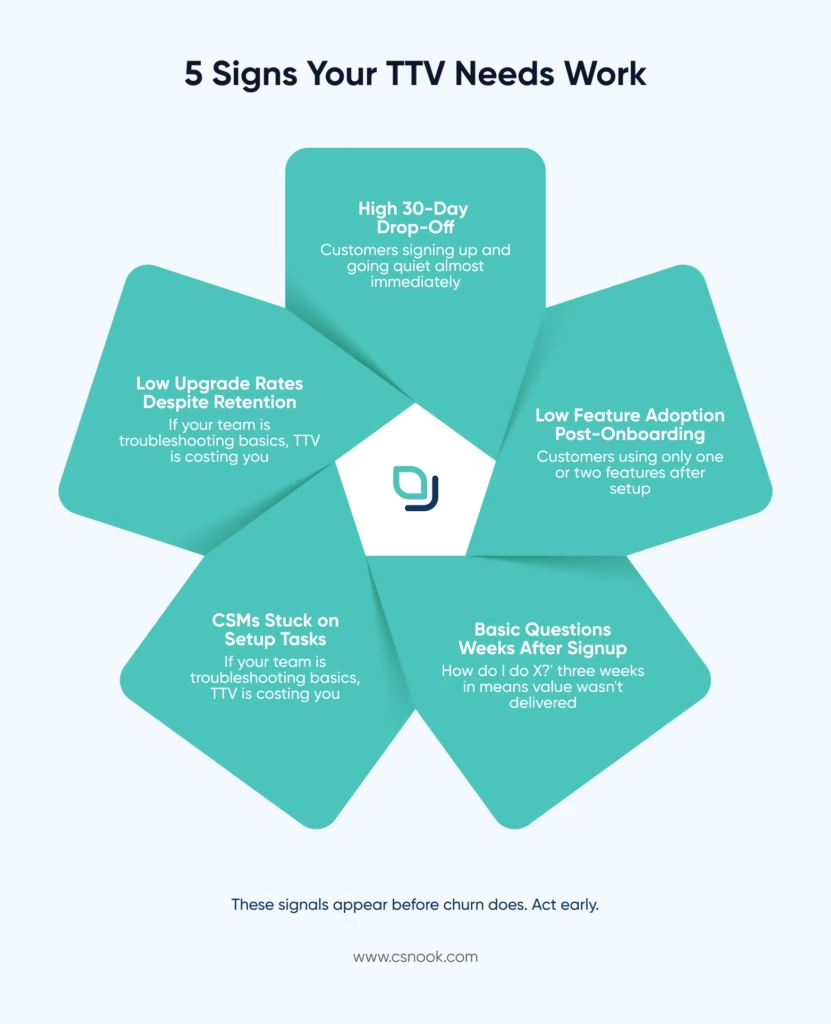
CSMs spend most of their time on setup
When your CSM is stuck supporting basic setup rather than generating strategic success, your TTV ‘s going to cost more than just retention.
Low upgrade rates despite decent retention
Customers are staying, but still no signs of expansion? That means they have not fully realised their total value. They are simply surviving and are not thriving.
The good news? These signals appear before churn does. Which means there’s still time to act.
How to Shorten Time to Value
Shortening TTV is not just rushing your customers through onboarding. Rather, it’s about eliminating anything that prevents you from helping your customers to achieve their first win.
Define What “Value” Actually Means for Your Customer
You cannot shorten your customer’s TTV if you don’t even know what that value is for them.
It’s not completing a setup checklist or clearing onboarding successfully. “Value” is achieving a desirable outcome that aligns with the customer’s desired result.
For example, the customer success team will consider the first win for their customers to be identifying an at-risk customer account using a customer health score dashboard and not the full CRM integration.
Have this conversation early. Align on the customer’s definition of success before onboarding begins.
Remove Friction From the Onboarding Path
Don’t just follow the onboarding manual. Always audit your onboarding flow with one question in mind: Does this step move the customer closer to their first win?
If the response is “no”, eliminate it, delay it, or automate it. Every extraneous step (like an added click) raises doubt and adds delay. The early stages of the onboarding process should be absolutely focused on getting to first value as fast as possible. The advanced features, integrations, and configurations can wait.
Personalize the Journey Based on Customer Goals
If you also have a generic onboarding flow, you should forget about a quick time to value.
Customers who receive a customized experience, specifically one that matches their use case, team size, and objectives, will move more quickly in achieving a successful outcome. This is because they don’t have to sift through irrelevant content to find what they need. Each action they take appears to be purposeful.
Ask 2-3 qualifying questions at signup and use the answers to create differentiated onboarding paths. The more relevant the experience, the shorter the distance to value.
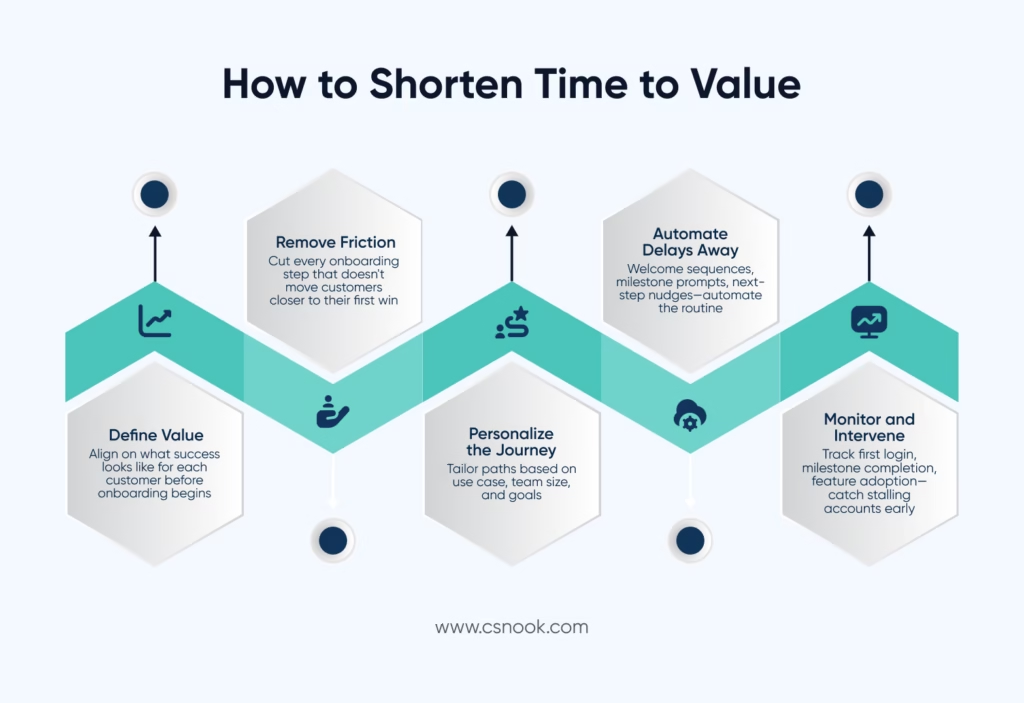
Use Automation to Eliminate Delays
In the age of automation, who uses manual setups? Manual follow-ups and slow check-ins quietly add hours and days to TTV.
To keep the momentum alive for customers from the time they sign up to the next time they come into contact with your team, automate the welcome sequence, milestone reminders, and reminders for upcoming steps.
Monitor and Intervene Early
Your work begins way before the onboarding. From day one, keep track of time-to-first-login, milestone completion rates, and feature adoption.
Establish health score alerts for accounts that become inactive within one week of creating an account. If an account has not logged in by the 3rd day of its lifecycle, they aren’t merely inactive, they are also at risk of churning.
Proactive outreach during this window can help reverse an account before the assumption becomes reality.
Conclusion
How quickly your customers achieve value is an indicator of how well you know them and how effectively you execute that knowledge with your team.
The shorter the time to value, the higher the activation, retention, expansion, and advocacy.
Tools like CSNook give customer success teams real-time data on customers’ initial onboarding activity so we can spot customers who are stalling before they have a chance to become churn statistics.
The faster your customers win, the longer they stay.
Common Questions
What is time to value in SaaS, and why does it matter?
Time to value refers to the period between when a customer signs up for a product and when they see their first meaningful result. This is important because if customers don’t see value quickly, they are likely to lose interest in using the product, thus making TTV one of the best early indicators of long-term retention.
What is the difference between time to first value and time to full value?
The time to first value is when they get their first meaningful win (activation moment), and the time to full value is when they see all the potential that can come from using the product. First Value is what helps drive early retention, while Full Value helps drive expansion and advocacy.
How can SaaS teams measure time to value effectively?
Start off by defining your activation milestone, followed by measuring time-to-first-login, milestone completion rates and how well customers adopt features. It is important to establish how to measure value (TTV) based on what the different customer segments consider as value, not just if they completed the onboarding checklist.
What causes slow time to value in B2B SaaS products?
Some of the major problems are a poorly defined generic onboarding flow, heavy product tours with features during the first week of use, no activation milestones established, delays with human check-in, and no way of seeing customers’ real-time progress. Each of these creates more friction between signing up and a customer achieving their first significant win.
How does improving time to value reduce customer churn?
When customers receive value sooner, they will see positive results and feel confident about their purchase before they have time to hesitate. Gaining early results builds trust and develops habits that increase the retention of customers and ultimately reduce the costly early loss of customers for most companies providing SaaS.


