At a churn rate of 5% per month, this equates to losing almost 50% of your customers by the end of the year. Nevertheless, the majority of SaaS CEOs think about acquisition rather than retention.
The twist? As per Bain & Company, retaining only 5% more of your customers can increase your bottom line by 95%. This is incredible. However, it garners only a small fraction of the attention that acquisition does.
This blog explains what churn is, how to calculate it, what the benchmark should be, and how to reduce it.
What is Churn Rate?
Customer churn rate is the percentage of customers or revenue you lose during a specific period. People usually measure this either monthly or annually. In other words, it’s your business’s leak rate (where leak means customers unsubscribing).
To sum it up, for every customer who signs up, how many leave?
People fail to realize just how much this matters. This measurement is a clear indication of your product or market fit, level of customer satisfaction, and whether or not you have actually created a product that solves customer problems. If not, why else would they leave?
But don’t get confused like most CS teams. Churn rate can be calculated in two different ways, and both of them are polar opposites:
- Customer Churn (also called logo churn): It means counting the number of accounts you lost. Actual people. Lost 5 customers out of 100? That means a straight-up 5% customer churn.
- Revenue Churn: It measures the financial impact. Losing 1 customer paying $5,000 per month hurts far more than losing 10 customers paying $100 per month. Same kind of logo churn, but the business impact? Vastly different.
This distinction matters, but why? That’s because a small number of high-value customers can mask a healthy churn rate, that’s until they don’t.
How to Calculate Customer Churn Rate
The math is simple, but the implications? Surely not.
The Basic Formula
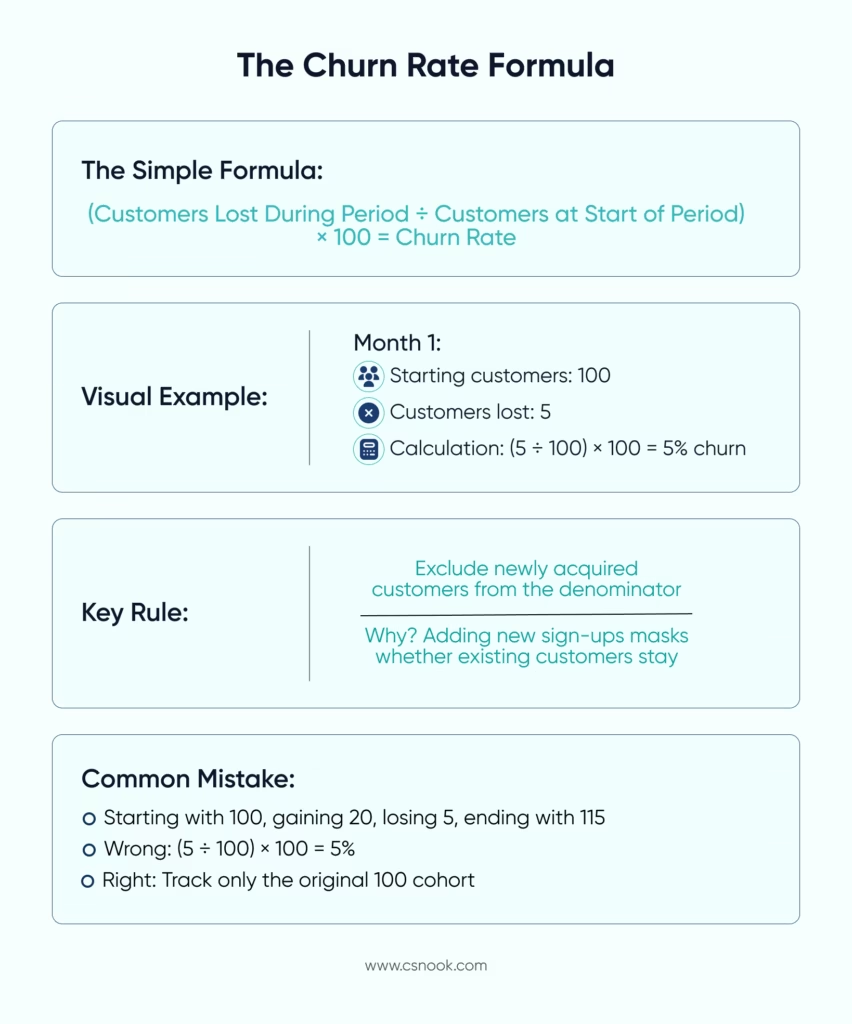
Customer Churn = (Customers Lost During Period ÷ Customers at Start of Period) × 100
For example, if you begin the month with 100 customers, and five of them cancel, then your customer churn would be 5%.
It might seem simple and clear at a glance. However, by itself, it lacks context as to how it relates to your business.
Gross vs. Net Churn
There are two important terms to understand when looking at churn:
- Gross Churn tells you the total loss amount due to cancellations and downgrades, without offsetting growth.
- Net Churn subtracts total expansion revenues from the total amount of lost revenues. This is where it gets interesting.
Let’s say you lose $100,000 in MRR, but you gain $120,000 in upgrades and seat growth. You’ve just achieved negative net churn. This means you’ve gained MRR even though you’ve lost customers. That’s the goal.
Monthly vs. Annual Calculation
Trends and early indicators of monthly customer churn rate can orient your decision-making moving forward. If you’re able to track it weekly, do so.
Annual churn uses compound calculation and cannot simply be derived by multiplying monthly data by 12. For instance, 5% monthly churn does not equal a 60% annual churn. Instead, you experience approximately 46% annual loss after compounding.
Compound Annual Churn Formula:
Annual Churn = 1 – (1 – Monthly Churn Rate)^12
The loss is compounded because you are losing a percentage of what remains each month rather than a fixed amount each month.
Pro tip: You should monitor and review both monthly and yearly churn to understand current trends and how they impact your business in the long term.
Churn Rate Benchmarks By Company Stage
Churn rates alone don’t tell you anything unless you also consider context. Here’s how you actually compare.
Early-Stage SaaS (<$1M ARR)
The normal churn rate is 6-8% per month. You are still finding your product-market fit with minimal customer success processes and experimenting with messaging. Don’t freak out.
Growth-Stage SaaS ($1-3M ARR)
The target customer churn rate is 3-5% per month since this stage is where the company’s product begins to solidify and build a real customer success team. Churn will continue to decline as the company focuses on refining and better matching its customers.
Established SaaS ($8M+ ARR)
Monthly loss rates of 2-3%. Companies increase operational efficiencies, have developed mature customer support teams, and have shifted focus towards higher quality customers or segments. Scale enables you to leverage your retention rate.
Enterprise SaaS
An average annual loss of 1-2%. Having multi-year contracts, deeper integrations and high costs of switching help to lock customers in. Therefore, at this stage, loss is almost a luxury problem.
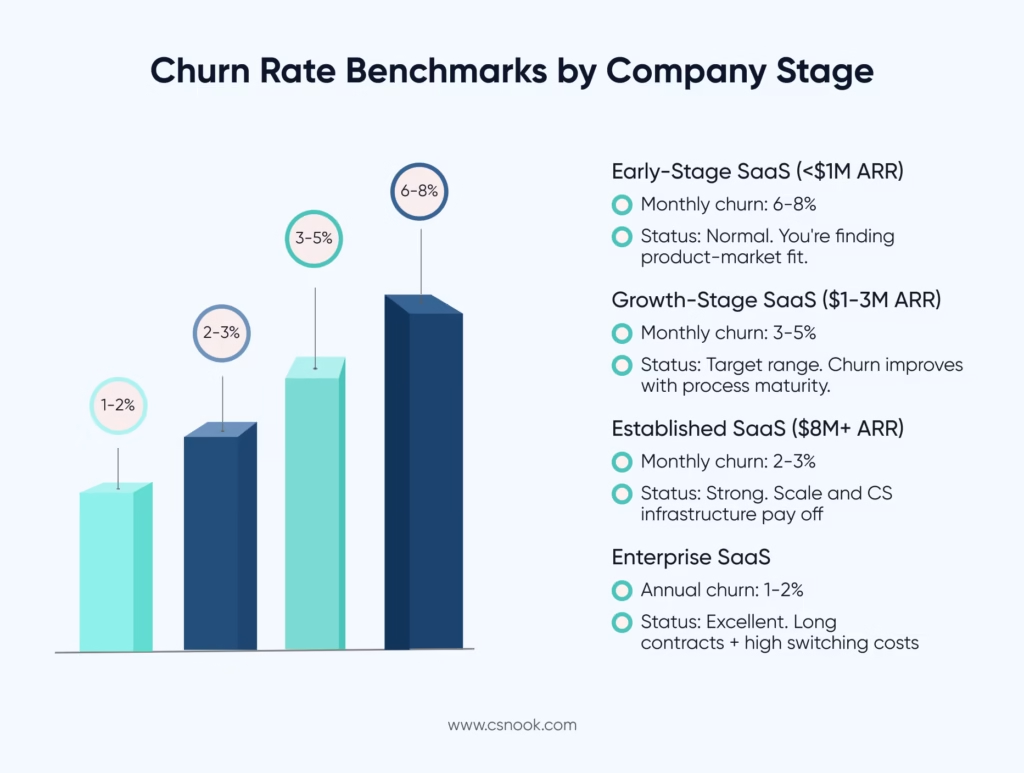
The pattern is clear: over time and with the introduction of new and better processes in place, the rate of churn decreases. The majority of leaders in the SaaS environment underestimate the degree to which their customer churn rate issue can be addressed by simply implementing better processes, not changing their product offering.
Why Customers Churn
Churn belongs to two separate categories. They require two separate approaches. Get them confused, and you’ll be wasting your time working on the wrong issue.
Voluntary Churn
Customers are making an active choice to discontinue service. The reasons for this choice are well known:
- Absence of perceived value (didn’t reach time-to-value)
- The pricing model doesn’t justify the result anymore
- The product doesn’t help them anymore with their main problem
- Discovered a better solution
- Restructuring the business or budget cuts
Voluntary churn is based on a product-market fit, onboarding effectiveness, and ongoing engagement. Fixing voluntary churn is difficult because it requires overcoming some type of real challenge.
Involuntary Churn
Payment failures, old credit cards, billing mistakes, and tech problems. Involuntary churn occurs accidentally, not by intentional means.
Customers do not want to leave—they simply cannot stay, as their payment just fails. Unintentional churn can account for 20-40% of losses across a number of SaaS businesses, and many teams have failed to address this issue.
The good thing is this is one of the simplest wins. Implementing automation for updating card numbers, smarter payment retry functionality, and creating effective dunning processes can all help recover up to 70% of what would normally be lost revenue with very little effort.
Secret sauce? First, fix involuntary churn. Easy pickings that compound quickly.
How to Reduce Customer Churn Rate
Now that you know what churn is and the reasons behind it, let’s look at the actual drivers.
Fix Time-to-Value First
As many as 70% of SaaS customers churn within 90 days because of a bad onboarding experience. Solution: define the activation point (critical step which determines whether the customer will stick around or not), then focus on optimising for it.
Address Involuntary Churn Head-On
This is the easiest win. Simply adopt automated card account updaters, apply intelligent retry algorithms to failures, and shoot out dunning emails within 24 hours after any failure.
Intelligent retry algorithms recover many more payments than single-retry algorithms
Example: Slack has joined hands with Stripe to implement card account updaters and adaptive acceptance technology, which can automatically get updated card account information when cards expire and retry selected payments.
Build Predictive Monitoring
Three things to track on a weekly basis for keeping customer churn rate in check are:
- login frequency (any reduction by 30%+ is a huge red flag),
- feature utilization (are they utilizing important features of the product?),
- and support satisfaction (any negative tickets should be taken as a cue for their frustration).
If any account shows more than one red flag at the same time, initiate CSM intervention calls immediately.
CSNook helps you do that in real-time and in an automated way without any extra effort.
Reduce Buyer’s Remorse at Renewal
Do not leave until the renewal cycle. Communicate quarterly results (usage patterns, value created), acknowledge successes, and introduce upgrades as “next steps” and not upsells. Have renewal discussions 90 days in advance, not 30 days behind schedule.
Build Beyond One Champion
Engage two to three key decision-makers from the start. Update the entire team about product changes, not just the individual you work with. If your advocate moves on, the relationship does not go back to square one. It is the account manager’s duty to ensure the relationship doesn’t break
Conclusion
Customer churn rate is the metric that decides between sustainable success and perpetual struggle. While most SaaS players are concerned about customer acquisition, the truly smart ones focus on churn.
As we can see from the figures, even a small increase in customer retention rates of 5% can increase your company’s profitability from 25% to 95%.
Those who treat the issue of reducing churn as a strategy priority and not as an emergency solution develop a predictable, profitable business. Instead of scrambling for new customers, they keep existing ones and develop them.
It’s time to start tracking this critical metric and act on it. Because in SaaS, retention is now the core growth driver.
Common Questions
What is churn rate and how does it differ from revenue churn?
The customer churn rate calculates the number of customers lost during a period, irrespective of their value. Revenue churn calculates the monetary loss that comes from cancelled and downgraded customers. When two customers leave, the ratio is a 2% customer churn ratio, but their financial loss is totally different.
How do you calculate customer churn rate correctly?
Churn Rate = (Customers who Have Left ÷ Total Customers at the Beginning of the Period) x 100. Example: There were 100 customers at the beginning of the period and 5 left. Churn Rate = 5%. Note: New Customers should not be counted in the denominator.
What is a good churn rate for B2B SaaS companies?
Anything less than 1% per month (which is equivalent to 5% per year) is considered healthy. The typical annual customer churn for B2B SaaS firms is 3.5%. Enterprise SaaS has an annual churn rate of 1-2%, due to the presence of lengthy contracts. New companies typically have a monthly churn rate of 6-8%.
Why does churn rate matter more than just customer count?
Losing 100 customers is scary compared to losing 5 – until you notice that the 5 customers were worth $10K per month. Churn will show you the true state of your business. High churn means having to replace constantly just to stand still; low churn equals exponential growth.
How do you reduce customer churn rate effectively?
The emphasis will be on the following key areas: the onboarding process needs to be fixed to ensure that customers attain their value quickly (70% of churn occurs within the first 90 days), handling of involuntary churn through payment retries and card updates, and predictive monitoring.