Why did this customer churn if their customer health score was green?
It cannot be denied that most health scores do not accurately reflect important metrics. While customers seem to have a consistent level of usage and show healthy signs of a continued relationship, until a point. When renewal comes around — poof! Gone!
The truth is that a real health score must be more than just a dashboard feature. It’s an operating system designed to help you predict potential churn 60 days ahead of time, identify expansion opportunities and provide visibility to enable your team to take action before it’s too late.
This article will explain how to build, implement and take action based on a real predictive health score instead of what looks good on your dashboard.
What is a Customer Health Score?
The health score is an amalgamated metric that takes the information provided by behavior, engagement, financial, and relational metrics to arrive at a single score that reflects the likelihood of the client being able to renew, expand, or churn.
In essence, you could view your accounts as having their very own “vital signs monitor”. The way that a doctor would not provide a diagnosis on the basis of a single reading, so too is the case for your health score — multiple sources of data come together to form the composite view of your health.
What It Looks Like in Practice
A customer success manager believes an account is doing well when the primary contact is responsive, answers all emails, and the last phone conversation was pleasant.
However, product usage had slowly declined by 40% over the last 30 days, and two key users had not logged in to the product in 3 weeks. In addition, multiple support tickets that had been submitted due to an ongoing core workflow problem were still unresolved.
While everything appeared perfect in the relationship from outside observations, the data told a very different story.
Health scores close the loop on conversations and enable support staff to view the condition of each account objectively from something other than customer communication, such as frequency and recency of contact from a CSM.
The output is typically on a 0-100 scale or a red, yellow, or green framework. Simple to read, but only as powerful as the signals feeding it. And that’s where most teams get it wrong.
Why Customer Health Scores Matter
Dealing with five accounts is easy because your instinct will do all the work. You know who everyone is, and you’ll know instantly if anything feels wrong.
But what about managing 50 accounts? It’s hard to even keep up with numbers, let alone your intuition working.
This is when health scores move from a “nice to have” to a vital component of operational effectiveness. Health scores give customer success teams a systematic, collected view of each account’s performance in a consistent, prioritised order with regard to all accounts, as opposed to just loud accounts.
The Cost of Getting It Wrong
Want to hear an uncomfortable truth? The churn that surprised you is actually the churn that you could have prevented.
According to Bain and Company’s 2024 Technology Report, 75% of software companies experienced reduced net revenue retention rates in spite of increased investment in customer success. Typically, failure to detect early warning signs results in an inability to intervene until too late.
Health metrics, based on manual reviews, generally do not uncover issues until they’ve come to light. By then, it’s already too late, and you can no longer engage in a meaningful manner. A consistently monitored customer health score can be used to notify you of early signs of a decline so that you can take action before it’s too late.
Without a structured system, most teams find out about churn risk far too late to do anything about it.
It’s Not Just About Churn
Besides providing security, health scores can tell you how much the accounts have scope for growing:
- Accounts which are nearing capacity,
- teams with high adoption rates
- And customers who are poised to grow without saying anything.
The cross-functional approach provides an additional advantage. Forrester’s 2024 research puts a number on this: customer-obsessed organizations — those with shared visibility into account health across teams — achieve 51% better retention and 41% faster revenue growth than those operating in silos.
By having sales, support, product, and customer success teams all working from the same health score, their conversations will be aligned. Therefore, sales won’t attempt to upsell a customer who is likely to be in a precarious position, and support won’t treat a key account like they would treat any other ticket.
Churn rarely occurs as a surprise; it is typically simply a signal that may have been overlooked.
The Signals That Actually Matter
Not all signals are created equal to calculate customer health score. Some feel important but don’t actually predict anything. Here’s what does matter.
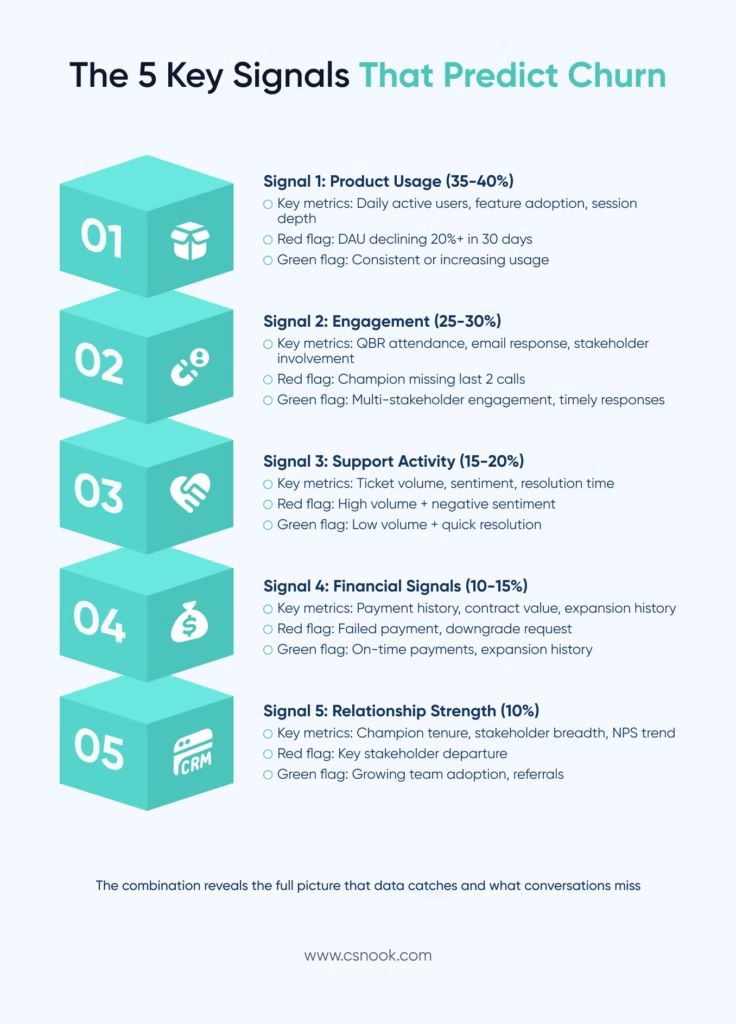
Product Usage
The single most significant predictor for either churn or expansion. Login frequency, adoption of features, number of active users, depth of engagement. All four of these factors help determine if the customer is realizing value from their purchase or paying you for access.
The twist? It’s not about absolute numbers, it’s about trends.
Imagine a customer who used to log in daily is now logging in weekly by month three. That is a straight-up red flag. On the other hand, a customer who’s always logged in weekly, consistently, is perfectly fine. Same frequency, completely different signal.
Tip: Measure and monitor the change in relative usage, not simply the amount of usage.
Engagement Signals
Key metrics such as email open rate, response time, quarterly business review attendance, and stakeholder engagement will determine whether your relationship is active or drifting.
What may concern you is when your champion has stopped participating in calls quietly, indicating they may soon officially churn. This information should also be reflected in the customer health score.
Picture this: Your key contact continues to receive all your messages and answer them promptly and courteously, but hasn’t participated in a review call in two months and has stopped involving other people on their team in discussions with you. This will not be considered a healthy account, but an account that has gone into autopilot mode.
Support Activity
Ticket volume, sentiments, resolution time, and frequency of problems are all relevant metrics. There is, however, a certain paradox here that needs to be explained.
Zero support tickets cannot simply be seen as good news; it can also mean that the user stopped asking because he no longer wants anything out of it. On the other hand, many tickets with negative sentiments clearly indicate a problem.
Financial Signals
Payment history, contract value, upcoming renewal dates, and past expansion or contraction all add context.
An account that has an expansive history evolving upwards generally creates a different story than an account that has continued to downsize over the last six months. Both accounts have the same revenue today; however, the two trajectories are entirely different.
Relationship and Sentiment
NPS scores, CSM pulse ratings, and stakeholder movement can provide insight into the people who make up the score when the raw data doesn’t tell you anything about them.
This is where intuition plays a role; when the CSM’s gut feeling and the score differ, that discrepancy is a red flag worth investigating. Churning customers often hide in this space.
How to Build Your Customer Health Score Model
If you think creating the health score is something that you can do one time and then forget about, then you are misled. It is an ongoing process that requires order and structure, iteration, and buy-in to be successful.
Here’s how to approach it.
Step 1 — Define What “Healthy” Looks Like for Your Product
Prior to scoring anything, there needs to be one question addressed — what behaviors specifically correspond with renewing?
Start by looking at your retained customers. What do they have in common at month three, month six, and month twelve? Now consider those who have churned — where did they differ from those who were retained?
For example, a customer success platform might discover that once the customers have built a customer health score dashboard in the first two weeks, those customers have retained above 90 per cent of the time. This is not just a coincidence but rather an activation point for building a model that behaves in the same way.
Step 2 — Choose Your Signals and Assign Weights
Not all signals are created equal. Different criteria for rating the importance of signals are outlined below in a framework that can be modified according to your data:
- Product usage: 35-40%
- Engagement: 25-30%
- Support activity: 15-20%
- Financial signals: 10-15%
- Relationship and sentiment: 10%
Tip: Start with the simplest rating possible. A team trusts and uses an easy-to-use four signal rating system every time over a complex twelve signal system that no one fully understands.
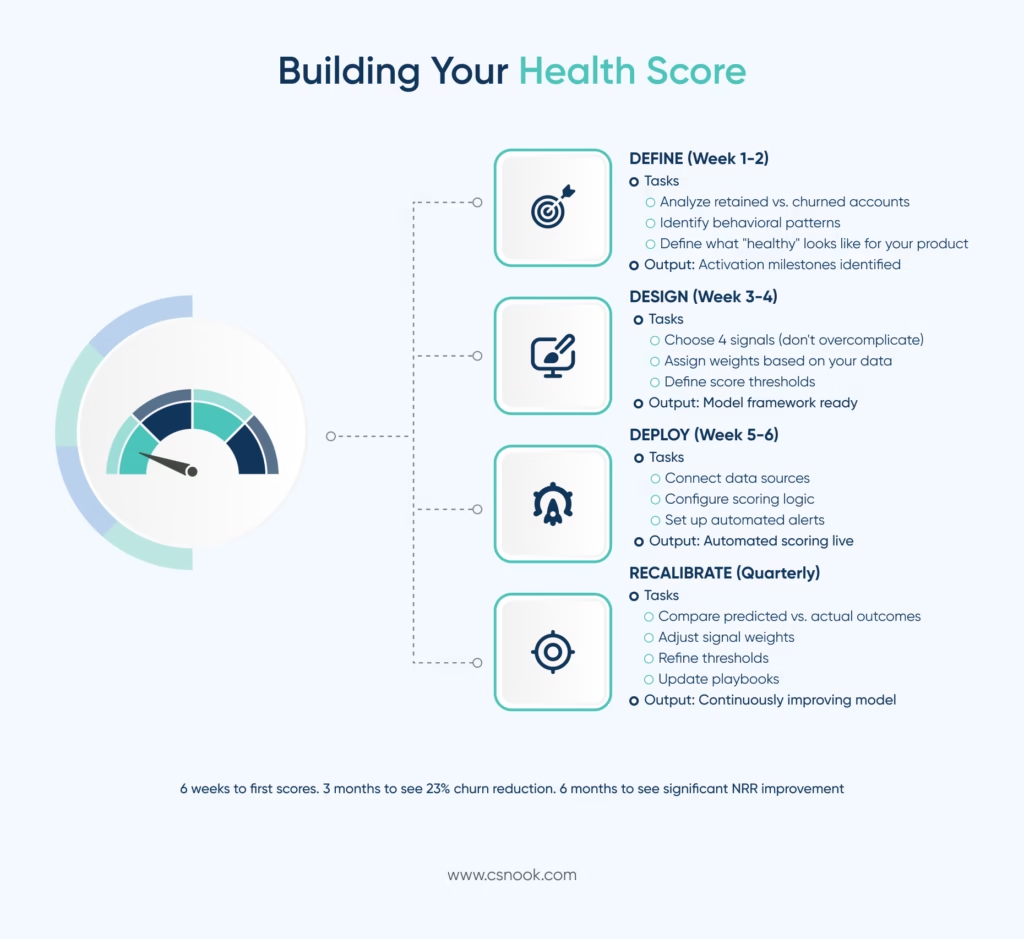
Step 3 — Set Score Thresholds and Define Actions
Without a response associated with the score, the customer health score is worthless. A common framework should look like this:
- 80-100 (Healthy): Regular check-ins should be performed, conversations regarding product feedback and position renewals should happen early, and expansion signs should be closely monitored.
- 60-79 (Monitor): Increase the frequency of the check-ins, find any areas that create friction before they become significant.
- 40-59 (At-Risk): Use the intervention playbook and bring in a high-level CSM.
- Below 40 (Critical): Immediate contact needs to be made and, if necessary, the executive contact should be reached out to.
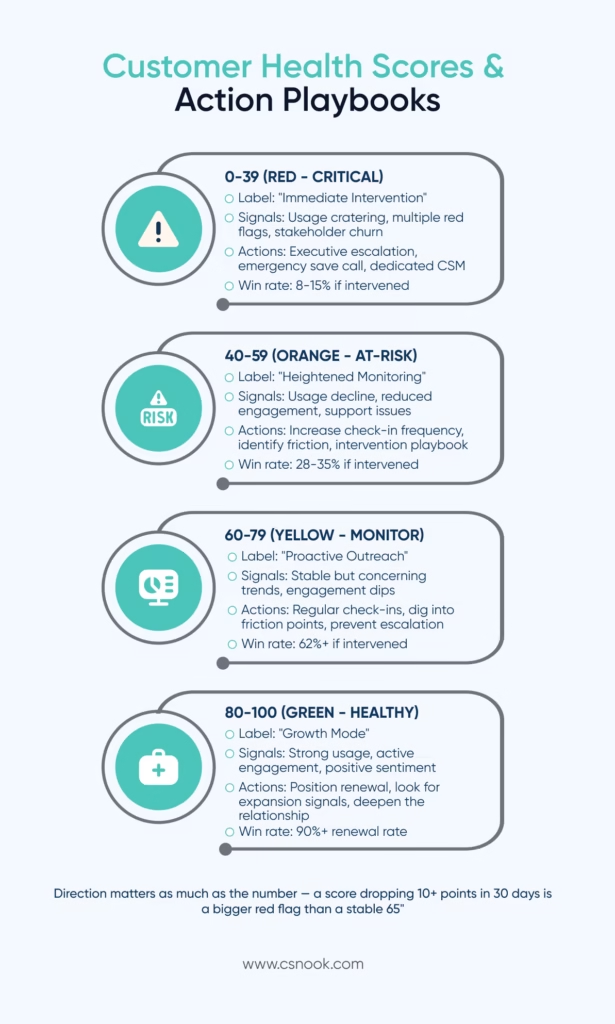
A score without an associated playbook will just be one more number on a dashboard that nobody is going to take action on.
Step 4 — Recalibrate Regularly
Your product changes, and so does your customer base. But does your predictive model change with your business needs?
A signal that predicted churn last year may not predict anything today. Therefore, review your predictive model at least quarterly by comparing what it predicted against what actually happened. Adjust your weights based on the gap.
If you do not do this, you will continue to score based on something that no longer has relevance.
Using Customer Health Scores to Predict and Prevent Churn
This is where health scoring fits nicely into your technology stack, not as a reporting tool but rather as an early warning system.
Take this illustration into consideration: There’s a customer who has a health score of 72 after 4 months of being in the account ( within “monitor” score range). Their usage is consistently staying the same. However, digging in shows two specific items that should cause concern: their NPS dropped by 15 points since last year, and their champion has not attended any of the last two QBR meetings.
If a CSM relied solely on usage data, they would never see this. However, the health score shows the divergence, which causes the CSM to perform a proactive intervention call. And it turns out that the champion is leaving the company. Nobody mentioned it, and nobody would have — until it was too late.
Since the score is detected early enough, a proactive CSM can onboard a new stakeholder before a transition crisis. The relationship between the two parties does not reset to zero. The account renews.
Whereas without the customer health score, that churn happens — sometimes silently — which creates surprise at the time of renewal. According to Bain and Company’s retention economics research, a 5% improvement in customer retention generates 25-95% higher profits, making early churn detection one of the highest-ROI investments a team can make. That’s two months of warning. Two months to intervene.
This is the real value of health scores: they don’t just tell you an account is at risk. They tell you early enough to do something about it.
Tip: Besides monitoring for accounts that are already red, you can set alerts for score decreases of 10 points within a period of 30 days, regardless of the account’s “healthy” state. In this case, the direction of the score is just as important as the actual number itself.
Using Customer Health Scores to Identify Expansion Opportunities
Most teams develop health scores to identify customer retention issues. However, the same scoring system can highlight potential expansion opportunities.
An account that is ready for expansion typically has the following characteristics:
- Usage is nearing the plan limit,
- Multiple teams are using multiple features
- The Net Promoter Score (NPS) has consistently had positive growth periods
- The account has a champion who is actively recommending the product without being asked
Consider this scenario: A team of 20 has heavily engaged in the platform for six months, and usage is currently at 85% of the available seat capacity based on the current plan. Their last NPS response was a 9. The CSM gets an automated alert flagging the account as expansion-ready.
The following discussion should feel more like “the next step” instead of a sales pitch. The facts support this. The customer is not being upsold, but is offered more of what already works for them.
The impact of health scores creates a scenario where expansion is, instead of opportunistically driven by a CSM identifying a pattern, a proactive and automatic function of the system itself.
Tip: Try developing an expansion threshold parallel to your existing churn-risk threshold. An example: 80-plus points, along with usage over 75% of plan allowances, marks the customer as someone who can be targeted for expansion — all without any active searching required.
Common Mistakes Teams Make With Customer Health Score
Even with the best intentions, teams often build health scores that look good on paper but fail in practice. Here’s what to avoid.
Tracking Vanity Metrics
DAUs (daily active users) and page views are often viewed mathematically. In many B2B SaaS products, these metrics have zero correlation with churn.
What matters is the trend relative to baseline — not absolute numbers. A customer who has been a steady 50 DAU would be less likely to churn than a customer who went from 200 DAU to 50 DAU.
Focus on what will actually provide insight into renewal and expansion for your product. For some, that will be with regard to the depth of their features. For others, it will be with regard to the breadth of their user base. Do not continue tracking numbers that appear to be important to you, and start tracking only those that will predict outcomes.
Treating Green as “Safe”
An 85 score decreasing to 70 in a two-week period is more alarming than a steady customer health score of 65.
Most teams usually focus on the absolute number, but smart teams focus on the trend. The trend going up in a poor-scoring account is better than a trend going down in a good-scoring account.
Creating a Health Score Nobody Will Use
This is a very frequent issue. A perfect health score could be placed on a dashboard, but no one would bother to check it out. Account managers would keep using their gut feeling.
To have adoption of the score, you will need these three things: a buy-in from the team, clearly defined playbooks linked to the score tier, and alerts that are automated and will force the user to look at them.
Never Recalibrating
Models that are set and then left to operate will change over time. For example, the last time a signal created an impact was six months ago. It may no longer be valid. The model should be reviewed on a quarterly basis by comparing predicted to actual health, and based upon that comparison, the model weights should be updated.
How CSNook Brings Health Scoring to Life
To use customer health scores properly, we need it to have the right systems around it. Infrastructure is critical in this regard.
CSNook’s health scoring engine takes individual signals of churn or expansion, including usage, engagement, and support interactions, as well as financial information, pulls them all together into a single score in real time and associates this score with possible actions to be taken.
When an account’s trajectory shifts, automatic alerts will be sent. Playbooks will trigger based on score thresholds. The CSM will see priority lists of customers to follow up with today, as opposed to having to do an analysis using a manually sorted spreadsheet.
Real-time visibility into onboarding progress allows for intervention to occur earlier and before disengagement becomes a churn decision.
The foundation of your customer success operating system is the health score. It is driven by onboarding and forms the basis of churn prevention. The health score will also help you find expansion opportunities and build your QBR outline.
Having a metric is one thing, but having a system is totally different.
Conclusion
A customer health score isn’t a metric; it’s the operating system for customer success.
Organizations that understand this can minimize churn rates and use health metrics for growth purposes. They detect risks soon enough to be able to act upon them, recognize growth indicators before the customers need to ask for them, and move on from emergency to strategic planning mode.
That being said, your health score is only powerful when used effectively.
But the most important thing to note is that the health score is only as important as what you do with it. So build the score correctly, recalibrate it often and let it drive your books, your workflows and your players. Most churn is not a surprise; it is a signal you missed.
The purpose of a good health score is to ensure you do not miss those signals.
Common Questions
What is a customer health score, and why do SaaS teams need it?
Customer health score is an aggregated metric that combines indicators from product usage, engagement, customer service and relationship, as well as financial metrics. SaaS teams need this composite metric to provide 60 days’ notice of potential for customer churn, which allows for proactive intervention instead of responses after the fact.
How do you calculate a customer’s health score correctly?
First, establish the five signals that include usage, engagement, support, financial, and relationship. After that, allocate weights depending on which signals lead to customer churn for your product, then create an aggregated 0-100 score and action thresholds. The trick is to keep it simple by beginning with only four signals as opposed to being swamped with twelve.
What’s the difference between customer health score and NPS?
An NPS takes one moment’s worth of customer response data, while a customer health score will measure many signals continuously (like behaviors, engagement levels, etc.). NPS’s predictive ability for churn is only 31%, while customer health scores with 4 or more dimensions can predict between 78%-85% of churn within 60 days.
How can customer health scores predict churn even before it happens?
Customer health scores identify behavioral trends that may include decreased usage, decreased engagement, turnover of stakeholders, and changes in support sentiment. This helps to classify customers into three stages of churn. An early warning has an 84% accuracy rate. This is because by knowing about customers’ issues in stage one, you can intervene when save rates are 62% instead of 8%.
What signals should be included in a customer health score model?
Strong signals include product usage, level of engagement (such as QBR participation), number and sentiment of support tickets, financial signals such as payment history, and relationship strength, such as champion tenure. Rank them based on your own experience with predicting renewals among your own customers.
How do you use customer health scores to identify expansion opportunities?
High-score accounts that use almost all their plan limits, have strong adoption of features, and have an increasing NPS are ready for expansion. Have another threshold for expansion: 80+ score AND 75%+ utilization of the plan. With automated alerts in place, it’s easier to have a natural-sounding conversation and not feel like you’re trying to sell additional services to the customer.