As a SaaS leader, are you also someone who places high importance on acquiring customers? You celebrate large contract wins and keep track of how many bookings you acquire.
However, what’s really important is having long-term sustainability, and that’s measured with NRR. It only asks one question: if you ceased gaining new customers tomorrow, would the company be able to grow, or would it begin losing revenue?
What is NRR?
Net revenue retention measures the amount of recurring revenue retained and increased from an existing customer base over a specified period (typically measured on a monthly or yearly basis).
That said, retaining customers isn’t all that matters. Customers paying you more money as they remain your client matters too.
This is a critical distinction and is the reason why it is different from a metric most people confuse it with: gross revenue retention.
The Difference
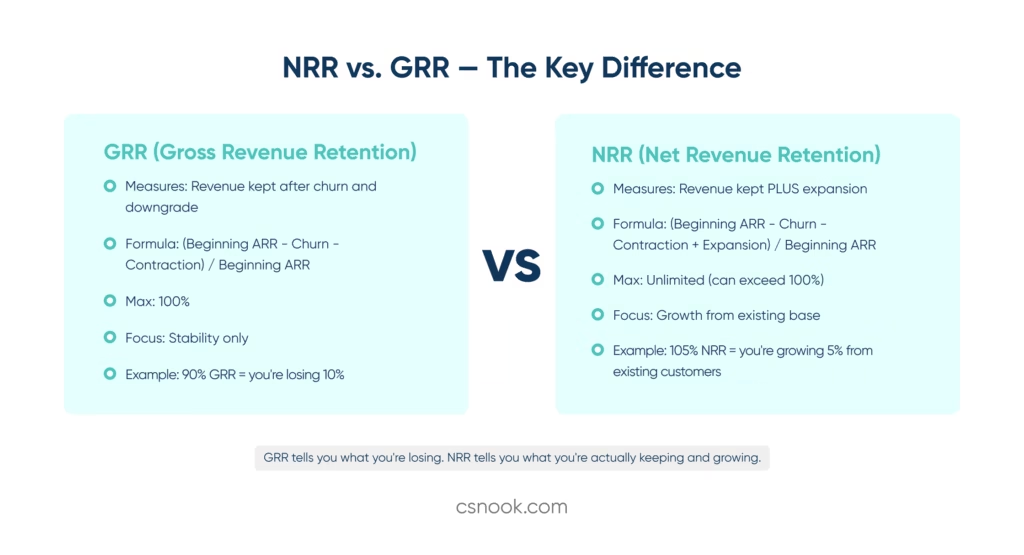
Gross Revenue Retention (GRR) includes the revenue after calculating the losses caused due to churn and downgrades and can reach a maximum of 100%. GRR is often considered a “glass half empty” metric.
NRR measures revenue you maintain plus revenue you generate by expanding, upselling, or increasing the price to existing customers. It can exceed 100%. Although both are important metrics, they measure different things.
Let’s understand this with the help of an example.
If ABC company has $100,000 MRR at the beginning of the month, and loses $10,000 due to customer churn, but gains $15,000 due to customer upgrades or additional seats.
Net revenue retention = ($100K – $10K + $15K) / $100K = 105%
This 5% monthly growth rate gets compounded each month. This means you get a whopping 64% growth by the end of the year. That too just from existing customers without counting any new sales.
How to Calculate NRR
The formula looks intimidating at first glance, but once you break it down, it’s quite simple.
The Formula
NRR = (Beginning ARR – Churn ARR – Contraction ARR + Expansion ARR)/Beginning ARR x 100
Seems difficult, I know. Here’s a definition of each component of the formula:
- Beginning ARR: Total annual recurring revenue from customers at the beginning of the period
- Churn ARR: This is the revenue lost due to customer cancellations
- Contraction ARR: Revenue lost due to a customer downgrading their subscription (lower tier)
- Expansion ARR: Revenue gained when a customer purchases additional products or services ( higher tier, or more seats).
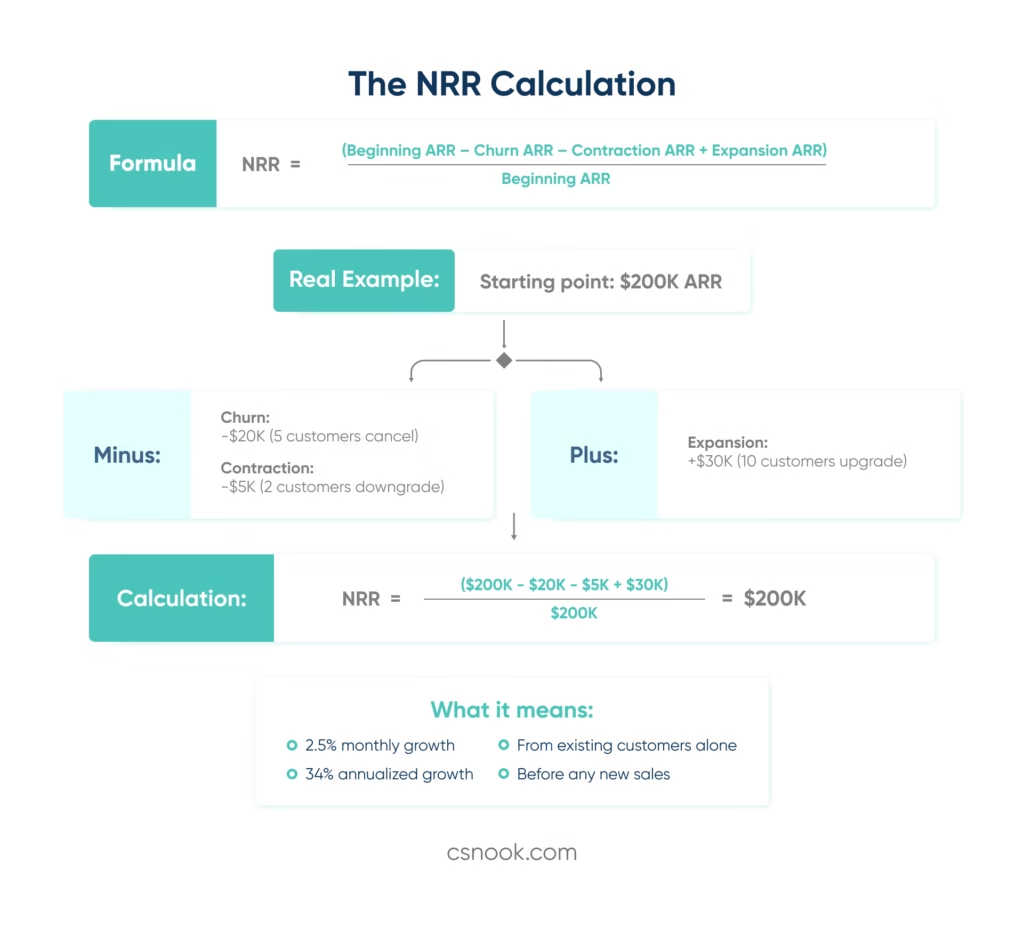
To make it easier to understand, let’s walk through an example.
At the beginning of January, you have an annual recurring revenue of 200K from 100 customers.
During the month:
- Customer churn: $20,000 (5 clients left)
- Contraction: $5,000 (2 customers downgraded)
- Expansion: $30,000 (10 customers upgraded their seats or plans)
In this instance, the NRR comes out to be ($200,000 – $20,000 – $5,000 + $30,000) / $200,000 = 102.5%
But that’s not all: A 2.5% growth compounded monthly will lead to a nearly 34% growth on a yearly basis for the existing customers.That is without accounting for any additional sales to new customers.
That’s how strong it is—you don’t need to rely on achieving your acquisition goals. You can just increase your underlying customer base.
Net Revenue Retention Benchmarks by Company Stage and ACV
Your NRR should be placed in context. Every score belongs to a stage:
Early Stage (<$1M ARR)
With a median NRR of 95%-98% because you’re still working on finding product-market fit, and your expansion playbooks are still being developed. Therefore, even if you are below 100%, no need to panic.
Growth Stage ($1M-$10M ARR)
The median value is between 102%-106%. Expansions should begin to pick up at this stage. You should be striving for a value of 105% or higher at this stage and should start to have repeatable upselling motions occurring.
Scale Stage ($10M-$50M ARR)
The median NRR for these companies at this stage is 110%-115%. Products that have a higher ACV have a higher value since larger deals have more opportunity for expansion than smaller deals.
Enterprise
The median net revenue retention for this company is greater than 120 %. Long-term contracts, full-time customer success representatives, and expansion across multiple users are the driving factors in achieving a very high NRR.
Now that we have an understanding of different enterprise levels and their corresponding revenue values, let’s discuss what ACV is and its value
The ACV Truth
Average contract value (ACV) represents the total revenue per customer on an annual basis. It will greatly impact your NRR capacity.
Expensive products yield a better net retention value. An annual contract worth $500K for an enterprise will obviously scale much larger than a $50 per month contract for an SMB. The enterprise can get more users, grow to different departments, and scale volume.
According to SaaS Capital’s 2025 performance metrics, companies with an ACV above $25,000 averaged a median value of more than 110%. Companies with an ACV below $5,000 averaged a median value of 85-95%.
Therefore, do not simply compare your net revenue retention to the median in your respective industry. Instead, compare your company’s NRR to other companies with similar ACVs.
Why NRR Is Your Real Growth Engine
Most SaaS leaders obsess over customer acquisition, but that’s exactly where they go wrong.
The truth is that high NRR can snowball as the years go by. Therefore, a company with 120% value will see much greater levels of growth than a company that has 95% due to the compounding effects.
Why? Let’s see the math behind it.
→ Suppose both companies start with $1M
→ At 20% growth annually from your customer base (120% NRR), this will compound on itself.
→ In year one, plus 20% (Company A: $1.0M × 1.20 = $1.2M, Company B: $1.0M × 0.95 = $0.95M). In year two, plus 20% on top of that larger number.
→ After five years, the disparity between companies with 120% and 95% NRR is astounding (Company A: $2.07M × 1.20 = $2.49M, Company B: $0.81M × 0.95 = $0.77M).
The Investor Signal
Before examining growth rates, investor interest in NRR has grown significantly in recent years. High levels of net revenue retention signify three vital things:
- Product-market fit: Your customers want more of what you’re selling to them.
- Capital efficiency: You’re able to grow your business without increasing your marketing expenses.
- Sustainability: You are not trying to grow your business at all costs.
Because companies with over 120% NRR have demonstrated a reliable and sustainable source of revenue, investors value them at a premium.
The Compounding Effect
Improving NRR by just 1% has a bigger impact on your organization over time. The difference between having an NRR of 105% and 110% may not seem as substantial now. But compounded over five years, it transforms your business trajectory.
Retention has moved beyond just being the responsibility of customer success and account managers, it has now become a business imperative.
How to Improve Your NRR
Improving your net revenue retention might seem like a big deal. But in reality, it’s just consistent and disciplined execution across three levels.
Prevent Churn
Get customers to their “aha moment” fast. Companies that have accelerated time to value see a significant decrease in churn. Monitor health scores and identify accounts whose health has dropped more than 60 days prior to them leaving.
Build strong relationships with multiple people in each of your accounts so that one champion leaving does not destroy that account.
Maximize Expansion
Upsells based on usage level are effective. When a customer has 80% of their plan limit met, suggest that they upgrade. Do not wait until they request an upgrade. Hold quarterly business reviews to display value regularly and position expansion as a natural outcome rather than as a sales transaction.
Negotiate Upward
In the renewal contract, include the price increase and the establishment of multi-year contracts to lower the customer turnover rate and strengthen customer commitments. Establish premium levels that provide a clear and meaningful path for expansion.
The Fastest Win: Improve Onboarding
If you’re looking to move up quickly, improve the onboarding process. Companies that achieve activation for their customers in less than 7 days see a marked increase in their first year of net revenue retention. This represents a quick win that compounds immediately.
The cost of acquiring customers is at its highest ever. This is why high NRR is very beneficial to the company in terms of competitiveness. The company can enjoy growth sustainably and not incur any costs in customer acquisition. It is what the investors will pay for your business and thus decide who wins.
Conclusion
Net Revenue Retention is more than just a metric for customer success. It’s measurable evidence confirming that your product is delivering more value on an ongoing basis.
Acquiring new customers has never been more costly than it is now. Therefore, having high NRR provides a significant competitive advantage. High NRR allows you to achieve sustainable growth and also means no cash outlays are needed to acquire customers. It determines how much investors value your company, which ultimately determines how you win.
Start tracking your NRR immediately. Then focus on getting better at it by 1% every quarter for the next five years. This simple approach is a total change to your company, enabling you to grow without needing to feed the acquisition machine.
This is how powerful NRR can be, and why it should be viewed as the most valuable driver of your business.
Common Questions
What is NRR and how is it different from churn rate?
Net revenue retention (NRR) indicates earnings maintained and created through the expansion of current clients. Customer churn determines how many clients are lost. Although NRR can exceed 100 per cent, the churn rate is always negative. While NRR marks growth potential, churn rate is indicative of revenue loss.
How do you calculate net revenue retention with a real example?
Formula: (Starting ARR – Churn ARR – Contraction ARR + Expansion ARR) / Starting ARR x 100. Example: Starting ARR is $100k, Churn ARR is $10k, and Upgrade ARR is $15k.
NRR = ($100K – $10K + $15K) / $100K = 105%. The additional 5% will compound annually to 64%.
What is a good net revenue retention rate for a SaaS company?
An NRR that exceeds 100% is great. The average B2B SaaS range is 102-106%. For enterprise organizations, the range is 115-125%; for SMB, it is 85-105%. Your range will depend on your ACV range but not on industry average. If you have a high ACV, you will achieve a higher NRR. Compare yourself to similar-priced companies, not the overall average.
How does net revenue retention impact company valuation?
Premium valuations are earned by high NRR companies. Those with one above 120% are valued 2-3 times higher than those with 95% at equivalent growth levels. This is because investors appreciate it due to its indication of sustainable and efficient growth.
What are the three main ways to improve net revenue retention?
Churn reduction: Get rapid time-to-value, health scores, and multi-threading.
Maximize expansion: Do upselling on a usage basis, conduct QBRs, and upgrade naturally.
Negotiate higher: Increase prices at renewals, provide multi-year contracts, and make premium offerings.
A well-balanced approach to all three ensures NRR improvement through compounding.