Here’s a question: What’s the difference between a customer who renews and one who becomes your loudest advocate?
The answer isn’t improved service levels and quicker response times. The difference lies in delighting customers.
To maintain the viability of a contract in a B2B SaaS environment, client expectations must be met. Going above and beyond in ways that clients didn’t expect will turn the transaction into a partnership. And the one who notices a usage pattern and suggests an optimization before the client struggles? It’s the CSM. It’s the proactive outreach that arrives exactly when it’s needed, not a day late.
But here’s the challenge: As teams scale, delight becomes harder to deliver. Personal touches give way to process. Proactivity gets buried under reactive firefighting.
So how do you keep the sparkle alive while growing? Let’s explore.
What is Customer Delight?
Customers are delighted when you go beyond what customers expect and do so in ways that surprise them positively. This means more than just fixing problems and following through on commitments. It is also about surprising customers with moments where they think, “Wow, they understand me and my needs!”
Here’s the difference.
Satisfaction means the product performs as expected. The onboarding process is easy, support ticket response times are good, and the renewal process does not cause any issues. You met the baseline.
Delight is defined as when the customer success manager identifies a usage pattern and reaches out to the customer in a proactive manner with an optimized workflow suggestion prior to them becoming aware of the need. It’s when a renewal conversation isn’t just transactional, but includes tailored insights that help them hit their quarterly goals.
In B2B SaaS businesses, the differentiation is evident from the longer contractual durations, increased switching costs, and much greater relationships. A satisfied customer will not just renew their contract; they will also spend more money, refer other potential customers, and help promote your business.
The difficulty?
You cannot delight your customers by simply “hoping” they’ll be pleased. Instead, to create a delighted customer, you will need insight into your customer’s behaviour, act on signals quickly, and have a system that enables your team to focus on activities that make a difference.
Why Customer Delight Matters for Growing Teams
When you have a small group of customers, it’s easy to make them happy. You know all your accounts personally. You can see friction points without using dashboards, and are aware of birthdays, what they use your product for, and their pain points.
But as you scale, that intimacy becomes more difficult to maintain.
Customer delightment is moving from a “nice to have” to being something that can be leveraged at a strategic level. Delightful B2B customers will not only stay loyal; they will also continue to grow with you.
They’ll upgrade their plans; they will add new seats; and they will expand into new teams. As such, by delighting your customers, you create sales assets in the form of referrals and case studies, as delighted customers become trusted advisors.
Here’s what customer delight directly impacts:
- Net Revenue Retention (NRR): Delighted customers expand faster and churn less.
- Organic growth: Word-of-mouth in B2B circles carries serious weight.
- Predictable revenue: When customers are genuinely happy, renewals become a formality, not a negotiation.
The data support the conclusions. Research shows that increasing customer retention rates by just 5% can lead to a 25%-95% increase in firm profits. And delighted customers? They are far more likely to remain, continue to spend, and to refer others to you.
In summary, delighted customers are not just a good way to provide quality service but also a driver of growth.
How to Achieve Customer Delight
Achieving delight doesn’t happen by chance. It’s the result of deliberate actions, smart systems, and a team that knows when to step in. Here’s how to make it happen.
Anticipate Needs Before They’re Voiced
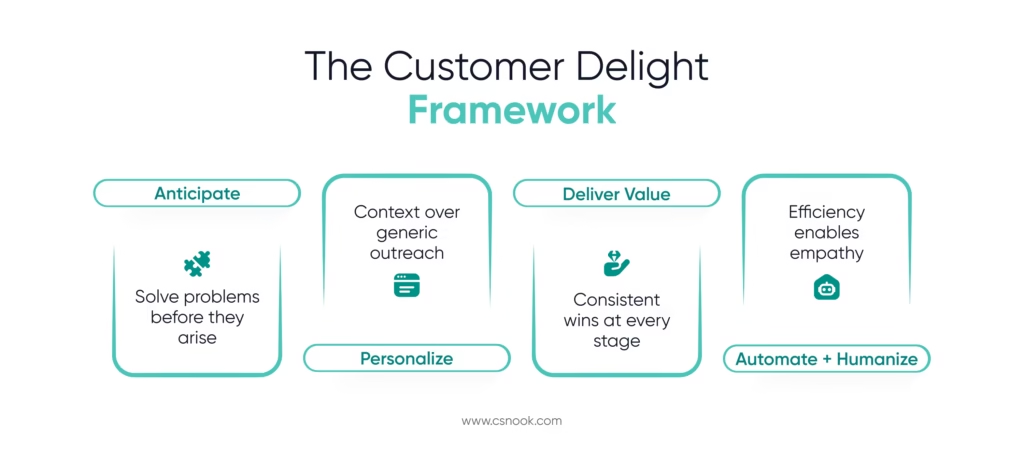
The most powerful form of delight? Solving a problem before your customer knows it exists.
Think about this: a mid-market SaaS company notices a client’s user seats are close to maximum. Instead of waiting until the client hits a wall, the CSM proactively engages the client to share the usage data, recommends an upgrade and provides an anticipated timeline to effectively transition.
The client did not explicitly ask for help; nevertheless, they received it. This is anticipation.
In order to identify behavioral signals such as product consumption data, level of engagement and trends in feature adoption, teams need visibility into these signals. When teams can see these signals, they can take action before issues arise. This allows teams to move from reactive fire-fighting to proactive customer satisfaction.
Personalize Every Interaction
Generic outreach feels transactional. Try personalized engagement, that feels human.
The expectation is already set. McKinsey research found that 71% of consumers expect personalized interactions — and 76% get frustrated when they don’t get them. In B2B, that frustration doesn’t just affect satisfaction. It affects renewal decisions.
Consider two renewal emails:
Email A: “Your contract is up for renewal. Let us know if you’d like to continue.”
Email B: “Hi Sarah, I noticed your team has been using our reporting feature heavily this quarter. Based on your usage, here are three ways to get even more value as you head into Q2. Let’s also chat about your renewal — happy to walk through what’s changed since you first signed on.”
The first one is the default message, while the other is a conversation.
To be able to personalize the customer experience, you need context, and this requires building a unified profile of the customer that integrates all relevant information, including product use, support history, and previous conversations. If you don’t have context, all interactions start at zero.
Deliver Consistent Value Throughout the Lifecycle
Gaining customer delight is not simply a one-off occurrence during onboarding or renewal, but rather something that happens through every phase of their customer journey.
Here’s what this looks like in practice:
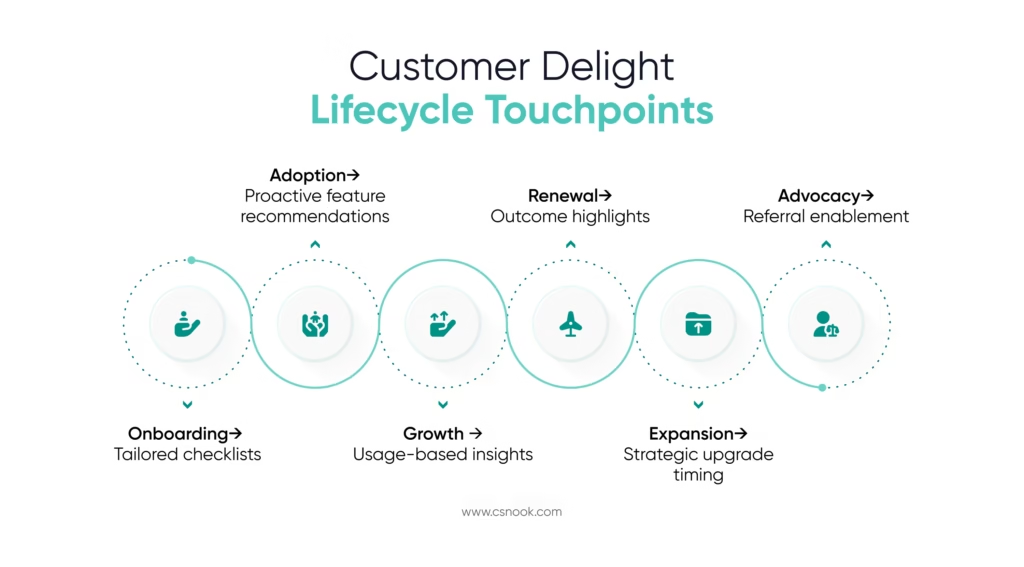
Onboarding Stage — Share a use-case specific checklist, rather than generic guides.
Mid-Contract Stage — Provide updates on features or benchmarks from your industry that will assist them in working more effectively.
Before Renewal Stage — Present them with measurable accomplishments that they have achieved with your product.
Each of these interactions should be used to answer the question, “How does this help the customer win?” The continuous delivery of value builds trust. Trust transforms satisfaction into advocacy.
Automate the Routine, Humanize the Important
Here’s the paradox: To deliver more human experiences, you need automation.
Automation is a very useful way to handle repetitive tasks like sending renewal reminders to customers, completing onboarding processes and tracking the health score of customers. This approach to customer delight frees up your team to focus on high-impact moments, such as strategic check-ins, expansion discussions and building relationships with customers that have a real impact.
Think of it this way: Workflows take care of the “when” and “what,” and your team should do the “how” and “why.”
The best customer success teams don’t choose between efficiency and empathy. They use one to enable the other.
Common Barriers to Customer Delight
Although teams have the best intentions, they often fail to provide fantastic experiences consistently. Most blocking issues are related to operations rather than culture.
Data Fragmentation across Several Tools
Most of your customers’ information is stored in a CRM system, their product usage can be found using analytics services, and their support history may be stored in a ticketing system. When data is fragmented, personalizing customers’ experiences becomes challenging.
Reactive Firefighting Instead of Proactive Engagement
Without proactive prevention systems, teams only receive feedback from customers once the problem has already occurred. This means that teams will be required to engage in damage control (and not delighting) before they can provide a fantastic experience for your customers.
Lack of Visibility into Customer Health Signals
Without full visibility into usage decreases, declining engagement, or changes to those who hold stakeholders, you will never be able to stay ahead of the curve.
Manual Processes that Cannot Adapt to Growth
When you have 20 accounts, working from spreadsheets or mental memory can be acceptable. At 200, it becomes a hindrance.
The good news? These aren’t “people problems”. They’re infrastructure problems. And infrastructure can be fixed.
When companies utilize platforms such as CSNook, they have the ability to combine all of the information related to their customers into a complete 360° profile and automate repetitive processes. This allows for teams to transition from firefighting mode to a proactive mode; thus enabling them to create a repeatable scalable plan for delighting customers through good customer service.
Final Thoughts
Customer delight isn’t accidental. It’s intentional, strategic, and repeatable.
Teams that proactively anticipate client requirements, offer customized connections and maintain consistent value do not merely retain clients — they turn them into advocates. In B2B, satisfaction is what keeps your customers stay; delight is what makes you outstanding.
Common Questions
What is the difference between customer satisfaction and customer delight?
Customer satisfaction is achieved when a product meets the consumer’s expectations for performance. Customer delight goes beyond meeting expectations; it provides unexpected value to the customer by creating on-memory experiences that make them want to spread the word about you and ultimately lead to repeat business.
How can B2B companies measure customer delight effectively?
Track Net Promoter Score (NPS), customer retention rates, expansion revenue, and unsolicited referrals. Monitor engagement patterns, feature adoption, and qualitative feedback. Customer delight shows up in behaviors — renewals without negotiation, proactive recommendations, and organic growth.
Why is customer delight important for SaaS businesses?
In highly competitive SaaS marketplaces, customer delight leads to increased retention, lower churn rates, and increased expansion revenue. Delighted customers are quicker to renew, have a greater likelihood of upgrading their plan, refer new customers to you, and provide you with valuable testimonials — making customer success a reliable method for driving growth.
What are some real examples of customer delight in action?
Proactively suggesting workflow optimizations before the client’s need them, providing personalized insights based on their usage patterns, providing upgrade options at the appropriate time, or providing industry benchmarks that will help your customers achieve their business objectives before they even know they want them.
How does automation help deliver customer delight at scale?
Automation handles routine tasks like renewal reminders, health score tracking, and onboarding sequences. This frees customer success teams to focus on high-value, personalized interactions — strategic conversations, relationship building, and proactive problem-solving that truly delights customers.


