Not all customers deserve the same level of attention, and it is a reality that all customer success teams must go by. Managing 10 or even 20 accounts and giving them the same amount of attention is still understandable, but as the number of accounts increases, it becomes more and more difficult to accomplish this.
- The accounts that needed proactive engagement get reactive firefighting responses.
- Accounts that have the potential to grow tend to get ignored.
- The ones that are about to churn go unnoticed.
In practice, this may lead to burnout, missed signals, and even churn that could’ve otherwise been prevented.
Customer segmentation, hence, becomes necessary. The customer success teams must analyse and decide on the customer accounts that deserve to be prioritized and the ones that do not require as much attention. It is important for CS teams to understand that they must not go by instinct.
Why ARR Alone is Not a Segmentation Strategy
Annual Recurring Revenue, also known as ARR, is the default way of audience segmentation. It is quantifiable and immediately reveals who contributes the most to the net profit.
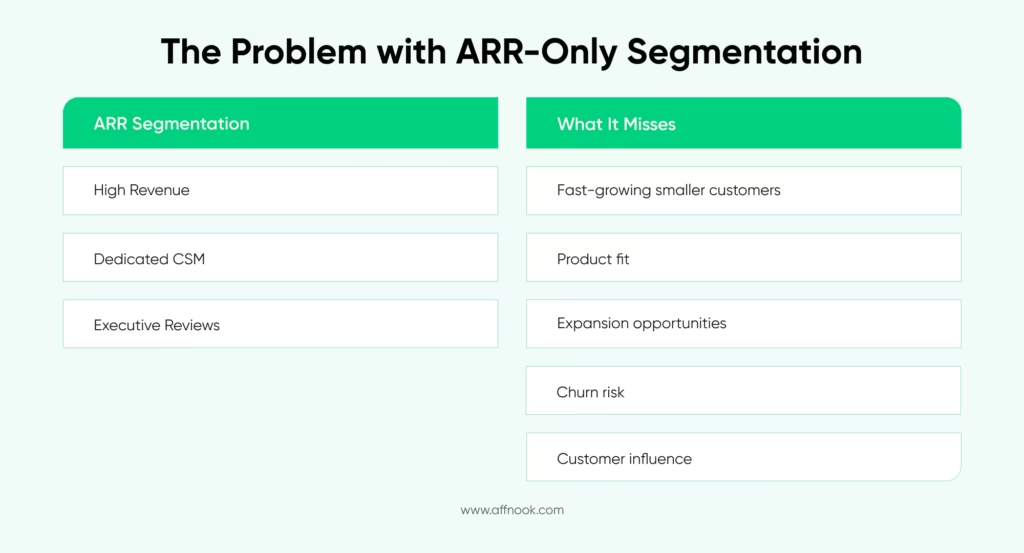
If a customer account pays a business $200,000 a year, it is provided with –
- A dedicated CSM
- A quality business review
- A direct line to leadership
Businesses that solely depend on ARR segmentation fail to keep notice of the blind spots that get created, which may also lead to the erosion of the customer base. What are these blind spots?
- The team starts to ignore accounts that may be small but are growing fast.
- It is oblivious to the value of customers who can refer the business to new markets.
- It misses accounts that are valuable but are also at high risk.
- It does not take into account the alignment of a low subscription account that may actually fit well with the product, or the fact that a high subscription paying account is completely misaligned with what the product promises.
The purpose of segmentation is not to identify who is paying more than the other. It is to figure out whether the customer account is aligned with what the product aims to deliver. This way, the CS team can allocate their energy to the customers who are actually able to resonate with the product and benefit from it.
So now the question that arises here is that if not just the ARR models, what other models must be taken into account?
Four Customer Segmentation Models Worth Knowing
There is no universal answer for how to segment. The ways are subjective. The one that suits the best for your product or service, and the customer base is the one that you must adopt.
Let us now understand some of the most commonly used frameworks.
Trait-Based Segmentation
This is the form of customer segmentation that is done on the basis of demographic characteristics such as industry, company size, geography, as well as traits. These traits are –
- Tech saviness – If the customer is highly technical (API-driven, prefers self-service documentation) or non-technical (needs step-by-step guidance, video tutorials, and phone support)
- Organizational culture – If the customer is a fast-paced start-up that can keep up with frequent product updates or if it is a change-averse organization that requires a thirty-day notice before a feature release.
- Vendor relationship style – if the customer views the business as a strategic provider or a utility provider that quietly keeps working in the background.
This matters for the customer success teams because, in accordance with this, the CSMs are assigned to the accounts.
For instance, an analytical CS executive would be assigned to the tech-savvy customers. A relationship-driven account manager, on the other hand would be connected with accounts that value high-touch corporate partnerships. This further reduces the friction churn.
RFM-Based Segmentation
Recency, frequency, and monetary segmentation are successful, especially in scaling B2B SaaS and product-led growth models. CS teams use this method to track customer health, engagement, and potential for expansion.
- Recency – How recently did users log in or perform a key action?
- Frequency – How often do they use the product? Is it daily or weekly?
- Monetary – What is their current ARR, contract value, or expansion spend?
This model of customer segmentation is especially important for identifying disengagement before it is too late.
For instance, it would show the churn signals of a high ARR account that has not logged in for 60 days and is not responding to emails. This is something ARR segmentation would not surface.
Value-Based Segmentation
It is an economic approach. It segments the customer on the basis of annual recurring revenue and customer lifetime value. It is best for allocating CSMs and prioritising accounts.
It also looks at factors like –
- ARR trajectory
- Product adoption depth
- Upsell opportunity
- Strategic fit.
High-value accounts receive dedicated, high-touch support like custom onboarding and assigned CSM engineers. Lower-tier accounts on the other hand are moved to tech-touch or community-driven support models.
Needs-Based Segmentation
This form of segmentation differentiates users based on the reasons they use the product. It could also be for a specific problem they want to be resolved.
Customers with similar use cases can be served through similar playbooks, which makes CS motion more consistent and coordinated while the team becomes more efficient.
Additionally, this also makes customer onboarding more convenient because if the CS teams know that the customer belongs to a specific needs-based segment, they can provide them with guidance that pushes them towards the features and outcomes that are the most relevant to them.
What Else Should Inform Prioritization
Models are just the structure and framework of segmentation, and they are not enough. Additional context is equally important, which also determines the day-to-day prioritization
Lifecycle Stage
This stage matters to a great extent. A new customer in their first 30 days needs would evidently require different engagement than those who are approaching their second renewal. Putting them together and running them in the same way produces friction for both.
Health Score
It is one of the most actionable inputs that CS teams can have. When the teams are able to track the following in real time –
- Product usage
- Engagement frequency
- Support ticket volume
- Behavioural signals
they don’t have to wait for the customers to actually tell them that something is wrong. The data reveals itself.
A healthy account at lower ARR might need less intervention than an at-risk account with higher ARR, and the team’s calendar should reflect that.
Expansion Potential
It is often underweighted in prioritization decisions. An account must not be judged by the current bill it is paying. If the customer is satisfied with your product and services, they have the potential to expand it across their company. Hence, they must be treated like the massive account that they might become.
Reference and Influence Value
This dimension does not show on the Excel sheet. Regardless of ARR, some accounts carry huge influence in the target market. A customer who is a respected voice in the industry, or who operates within a network of companies that are all potential prospects. They have a type of value that pure revenue segmentation tends to miss.
At the end of the day, word-of-mouth matters and has its own potential.
How to Put Customer Segmentation Into Practice
The practice of segmentation would only provide value when it is brought into practice.
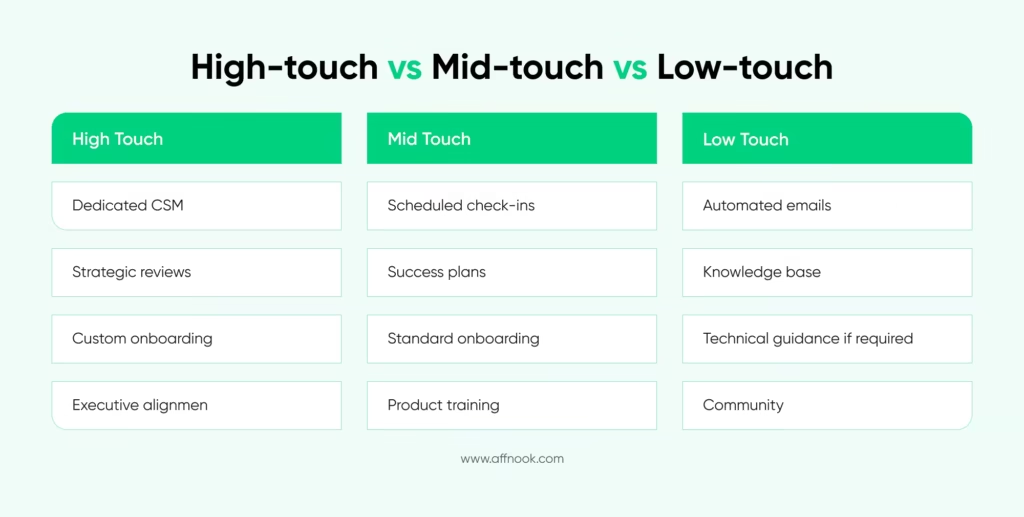
- Define your tiers, preferably into three, that is, high-touch, mid-touch, and low-touch. This will help in figuring out — how often CSMs reach out, what kind of outreach is relevant, and what level of customization is required in the relationship.
- Ensure that the customer segmentation is flexible because accounts move. A customer who was part of the mid-touch tier three months ago might show churn signals that require high – touch intervention. They may also have expanded enough to earn more investment. Segmentation that takes place only at the time when the contract is signed and is not taken into consideration later will eventually go stale.
- Build playbooks around segments and not accounts. Group similar customers together and use automated rules to trigger specific actions.
To Conclude
Manual segmentation that operates through Excel sheets must be refreshed quarterly and should be maintained by the CSM who may or may not remember the details, cannot sustain for a long time. There will eventually come a point when the manual segments stop reflecting reality.
Customer success software like CSNook prevents customer segmentation from being passive and periodic. Instead, they make it continuous and actionable. It allows businesses to organize customers on the basis of health industry, lifecycle, account manager, onboarding flow, usage or any other relevant variable of choice to deliver targeted strategies that get results.
Common Questions
What is the difference between customer segmentation and prioritization?
Customer segmentation groups customers with similar characteristics, while prioritization decides where the team should spend time today. A customer may belong to a high-value segment but still require less immediate attention than a lower-value account that is showing strong churn signals.
How often should customer segments be updated?
For most SaaS businesses, reviewing customer segmentation monthly or quarterly is a practical starting point. Fast-growing companies often update them more frequently because customer health, usage patterns, and expansion opportunities can change quickly
Why is needs-based customer segmentation useful for onboarding?
Customers who buy the product for similar reasons often need similar guidance. Grouping them by use case allows customer success teams to deliver more relevant onboarding, recommend the right features earlier, and create playbooks that can be repeated across multiple accounts.
Is ARR still useful for prioritization?
Yes. ARR customer segmentation is still an important signal because it shows the current revenue contribution of an account. The problem arises when it becomes the only signal. A complete prioritization model should also consider health score, product adoption, lifecycle stage, and expansion potential.